Not all driveways handle Long Island rain the same way. Here's what Nassau County homeowners need to know before choosing a permeable option.
Share:
Summary:
Most driveway guides will tell you permeable surfaces are great for the environment. That’s true — but it’s probably not why you’re here. You’re here because water is pooling near your garage, or your concrete is cracking for the third time, or you’re tired of the same cycle of patch, seal, and repeat. Nassau County gets roughly 44 to 48 inches of rain a year, with no real dry season, and the freeze-thaw cycle hits hard every winter. Your driveway takes the brunt of all of it. Here’s what actually works — and what to consider before you spend a dollar.
This is the question most homeowners land on eventually. Poured concrete is familiar and feels safe — but it’s a monolithic surface, meaning when it cracks (and in Nassau County winters, it will crack), you’re dealing with the whole slab. Permeable pavers are modular. Each unit moves independently, which means freeze-thaw cycles don’t cause the same cascading damage.
A cracked or sunken paver can be pulled and replaced in minutes without disturbing the rest of the surface. That selective repairability matters in a climate like ours, where winter damage is predictable and recurring.
The other difference is what happens to water. Traditional concrete and asphalt send stormwater straight to the street — or, more often in Nassau County’s older neighborhoods, straight to your foundation. Permeable driveways let water pass through the surface and into a crushed stone sub-base below, where it filters back into the ground. For homeowners sitting on top of Long Island’s sole-source aquifer — the same aquifer that supplies drinking water to millions of residents — that’s not a small thing.
“Permeable driveway” isn’t a single product — it’s a category, and the options range widely in cost, appearance, and performance. Understanding the difference between material types is the first step to making a decision you won’t regret.
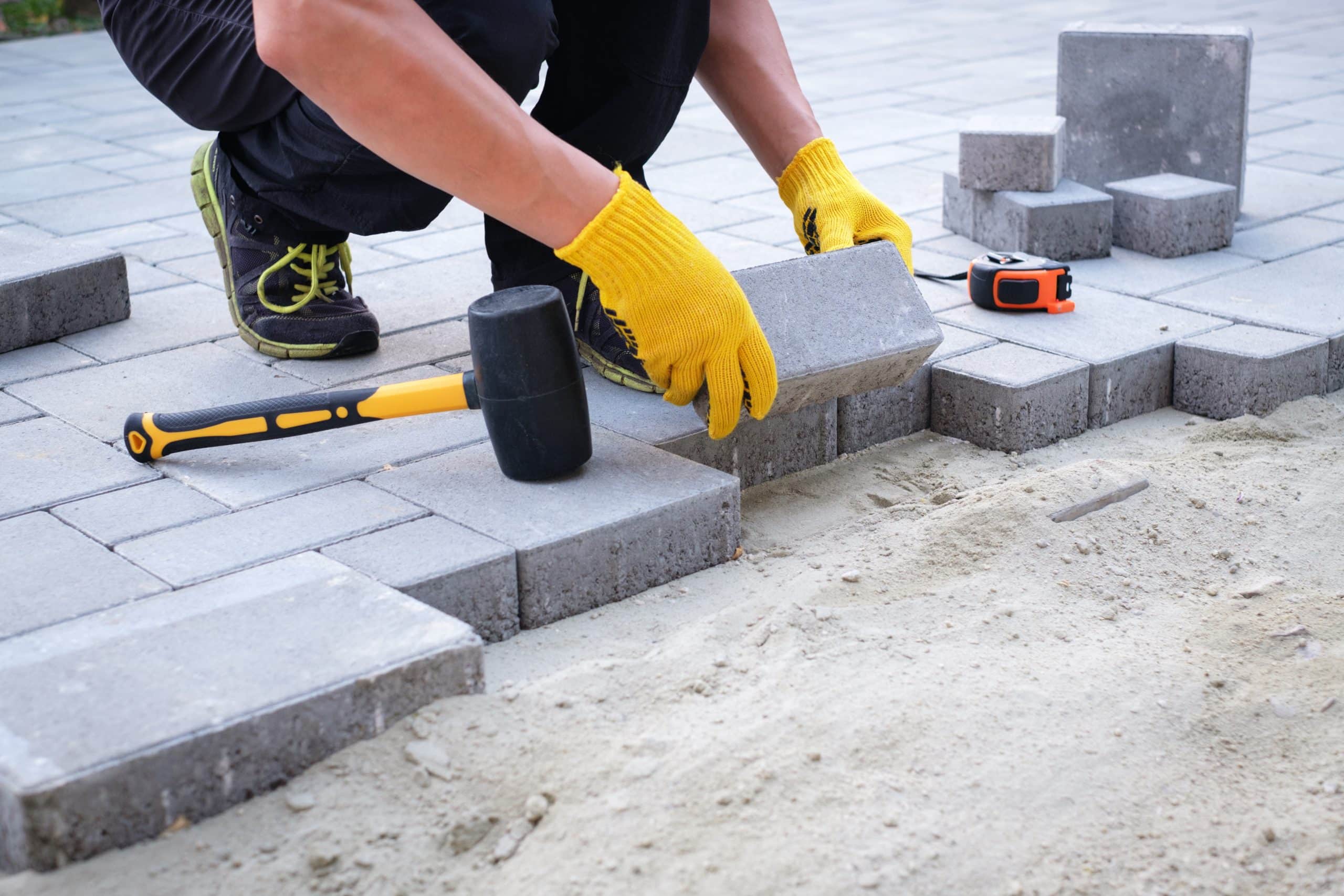
Permeable interlocking concrete pavers, often called PICP, are the most common choice. They’re engineered with open joints filled with chip stone aggregate — not sand, not polymeric sand — that allows water to drain through at rates of 5 to 20 inches per hour in a well-installed system. Brands like Nicolock make permeable-specific lines, including the SF-RIMA, which is designed to look and feel like natural stone while delivering that drainage performance. We carry Nicolock’s permeable paver lines at our Roslyn Heights showroom, so you can see and compare them in person before committing.
Natural paving stone is the premium tier. Bluestone, granite cobblestone, limestone, and sandstone can all be installed with open, permeable joint spacing rather than mortared joints — which means water moves through the gaps rather than sheeting off the surface. Natural stone driveways installed this way can last 50 years or more with minimal maintenance. The tradeoff is upfront cost, which we’ll cover in the next section. But for homeowners in communities like Roslyn Estates, Manhasset, or Garden City where curb appeal matters and the housing stock is higher-end, natural stone is often the right call for the long run.
Porous asphalt and pervious concrete are the more utilitarian options. They look similar to their traditional counterparts but are mixed with larger aggregates that leave voids for water to pass through. They tend to cost less per square foot than permeable pavers, but their lifespan is shorter — roughly 20 to 25 years — and they’re harder to repair selectively when something goes wrong.
Gravel is the most affordable permeable option and the simplest to install. It drains well by nature and handles freeze-thaw cycles without cracking. The downsides are practical: it shifts underfoot and under tires, requires periodic regrading, and doesn’t suit every property aesthetically. For a side yard or secondary access drive, it can make a lot of sense. For a main driveway on a finished residential property, most homeowners want something more refined.
The surface material gets all the attention, but the sub-base is where a permeable driveway actually works — or doesn’t. A properly engineered permeable system requires 6 to 18 inches of open-graded crushed stone beneath the surface layer. That aggregate base is what holds the water temporarily and allows it to filter down into the soil below. Skip that step, or compress the base with the wrong equipment, and the drainage performance disappears regardless of what’s on top.
This is why installer selection matters as much as material selection. Permeable paver installation is not the same as standard paver installation. The contractor needs to understand drainage design, aggregate gradation, and how to set the surface so water moves toward the permeable zones rather than away from it. The Interlocking Concrete Pavement Institute (ICPI) trains and certifies installers specifically for this type of work — and it’s worth asking any contractor you’re considering whether they have that background.
One maintenance point that surprises a lot of buyers: permeable pavers need annual upkeep to keep performing. The open joints that make drainage possible can accumulate fine debris over time. Annual vacuum sweeping — similar in effort to leaf blowing — keeps the system clear. What you should not do is use sand for ice control in winter. Sand will migrate into the joints and clog the drainage channels. Liquid de-icers or coarser materials are the right choice for permeable surfaces.
The Nassau County Soil and Water Conservation District actively endorses permeable pavement for residential driveways as a stormwater best management practice. The Town of Hempstead has a public permeable paver demonstration installation at the Clean Energy Park in Point Lookout — a useful reference if you want to see a real installation before deciding. These aren’t incidental endorsements. Nassau County operates a formal stormwater management program in partnership with the NYS Department of Environmental Conservation, and the regulatory direction is clearly toward reducing impervious surface coverage over time.
Want live answers?
Connect with a Powerhouse Mason Supply expert for fast, friendly support.
Cost is where most buyers get tripped up — not because the numbers are hard to understand, but because they’re usually presented without context. A price per square foot for materials means nothing without knowing what the full installed cost looks like, how long the surface will last, and what maintenance will cost over that lifespan. Here’s the honest breakdown.
Nationally, permeable interlocking concrete pavers run $10 to $30 per square foot installed. Natural stone permeable driveways run $25 to $50 per square foot installed. Porous asphalt falls in the $7 to $13 per square foot range, and pervious concrete runs $8 to $16. Gravel is the floor at $2 to $6 per square foot. Long Island pricing tends to run toward the higher end of those national ranges — labor costs here are real, and material delivery to Nassau County adds to the equation.
The cheapest installed paver option is gravel, followed by porous asphalt and pervious concrete. If upfront cost is the only variable, those are the answers. But the per-square-foot number at installation is only part of the picture.
Traditional asphalt lasts 15 to 20 years. Traditional concrete lasts 25 to 30 years. Permeable interlocking concrete pavers last 30 to 40 years. Natural stone permeable driveways, properly installed, can last 50 years or more. When you divide total cost — materials, installation, maintenance, and eventual replacement — by the number of years the surface performs, the math on permeable pavers often looks different than the sticker price suggests.
There’s also the repair cost factor. When a section of poured concrete or asphalt fails, you’re typically resurfacing or replacing a large area. When a permeable paver cracks or sinks, you replace that unit — sometimes just one or two pavers — without touching the rest of the driveway. For Nassau County homeowners dealing with freeze-thaw damage season after season, that selective repairability has real dollar value.
Labor accounts for 40 to 60 percent of a typical paver project’s total cost — roughly $5 to $11 per square foot just for installation. The national average total project cost for a permeable driveway sits around $7,500, with a range of $5,000 to $12,000 depending on size, material, and sub-base requirements. Long Island projects frequently fall at the higher end of that range.
Some municipalities with stormwater fee programs offer credits of $5 to $25 per month for permeable surface installations, and some jurisdictions offer rebates of $10 to $20 per square foot. Nassau County’s evolving stormwater regulatory environment makes it worth asking your local municipality whether any such programs apply to your property.
Concrete block pavers — the standard PICP product — and natural stone sit at different points on the cost and longevity spectrum, and the right choice depends on what you’re optimizing for.
Concrete block pavers, including permeable lines like Nicolock’s SF-RIMA and Eco-Tre, give you consistent sizing, predictable installation costs, and strong drainage performance. They come in a wide range of colors and finishes, and the better products — those using Paver-Shield technology, for example — carry color through the entire paver rather than just the surface layer, so they hold their appearance over time. For most residential driveways in Nassau County, permeable concrete block pavers hit the right balance of performance, aesthetics, and cost.
Natural stone options — bluestone, cobblestone, limestone, travertine, sandstone — carry a higher upfront cost but bring something concrete can’t replicate: the look and feel of a material that’s been used for centuries. Cobblestone driveways in particular have a timeless quality that suits older homes in communities like Port Washington, Roslyn, and Oyster Bay. Bluestone is a Long Island staple for a reason — it handles the climate well, drains effectively when installed with open joints, and ages gracefully. Travertine and limestone are premium choices with a warmer aesthetic, though they require more attention to sealing and maintenance in a climate with road salt and heavy winter precipitation.
There’s no universally correct choice. A working-class driveway on a modest lot has different requirements than a curved, landscaped entry on a larger property. What matters is matching the material to the actual conditions — soil type, drainage grade, vehicle load, aesthetic goals, and budget — and that’s exactly the kind of conversation our team has with customers every day at our Roslyn Heights showroom. We’ve been doing this since 2004, and the family behind Powerhouse Mason Supply comes from generations of masons. When you ask us about freeze-thaw performance or sub-base depth, you’re talking to people who’ve seen these materials installed and failing and lasting across Nassau County for decades.
If there’s one thing to take away from all of this, it’s that the surface material is only part of the decision. The sub-base, the installer, the joint aggregate, the maintenance plan — these are what determine whether a permeable driveway actually performs the way it’s supposed to over a 30- or 40-year lifespan. Getting those details right from the start is far less expensive than fixing a system that was installed incorrectly.
Nassau County homeowners have real options here — and a local resource to help navigate them. We carry permeable concrete pavers, natural stone, bluestone, cobblestone, limestone, travertine, and more as part of our outdoor living supplies, and we can connect you with experienced Long Island contractors who know how to install these systems properly. We also break pallets for residential projects, so you’re not overpaying for material you don’t need.
If you’re ready to start the conversation, stop by our showroom in Roslyn Heights or reach out to Powerhouse Mason Supply directly. We’ll help you figure out what actually makes sense for your property — no pressure, just straight answers.
Article details:
Share:
Continue learning: