Pavers or poured concrete? If Nassau County winters have anything to say about it, the answer might already be made for you.
Share:
Summary:
If your patio is cracking, heaving, or just looking worn out, you’ve probably already started wondering whether pavers are worth it. It’s a fair question — and the honest answer is more nuanced than most suppliers will give you. The upfront cost of concrete patio pavers is higher than poured concrete. That part is true. But upfront cost is only one piece of the picture, and for Nassau County homeowners, it’s often not the most important one. What matters more is what happens after the first five winters — and that’s where the two materials start to tell very different stories.
When people say “patio stone,” they usually mean one of two things: a manufactured concrete paver or a natural stone product like bluestone, travertine, or limestone. These are genuinely different materials with different performance profiles, price points, and maintenance requirements. Concrete pavers are engineered products — manufactured to precise compressive strength standards, available in a wide range of sizes and textures, and designed to interlock as a system. Natural stone is quarried, which means each piece is unique, and the variation in density and porosity affects how it handles weather over time.
For most Nassau County patios, concrete pavers are the practical starting point because they’re consistent, durable, and easier to source in quantity. That said, natural stone options are worth understanding before you decide — and we’ll get into those distinctions a bit further on.
Here’s the thing about poured concrete that doesn’t come up enough in the comparison conversation: it’s not heavy use that destroys a concrete slab. It’s water. Specifically, it’s the cycle of water seeping into micro-cracks, freezing, expanding, and then thawing — over and over again.
Nassau County sees roughly 15 to 30 freeze-thaw cycles in a typical winter. That’s not a guess; it’s a consistent regional climate pattern that plays out the same way on driveways, patios, and walkways across Long Island every year. A poured concrete slab is a monolithic surface. When the ground beneath it shifts — from frost, from root pressure, from simple settling — the slab has nowhere to go. It cracks.
Once it cracks, water gets in faster, the freeze-thaw damage accelerates, and within a few winters, what started as a hairline fracture becomes a structural problem. Patching slows it down, but it rarely stops it. Most patched concrete patios end up needing full replacement within a few years anyway.
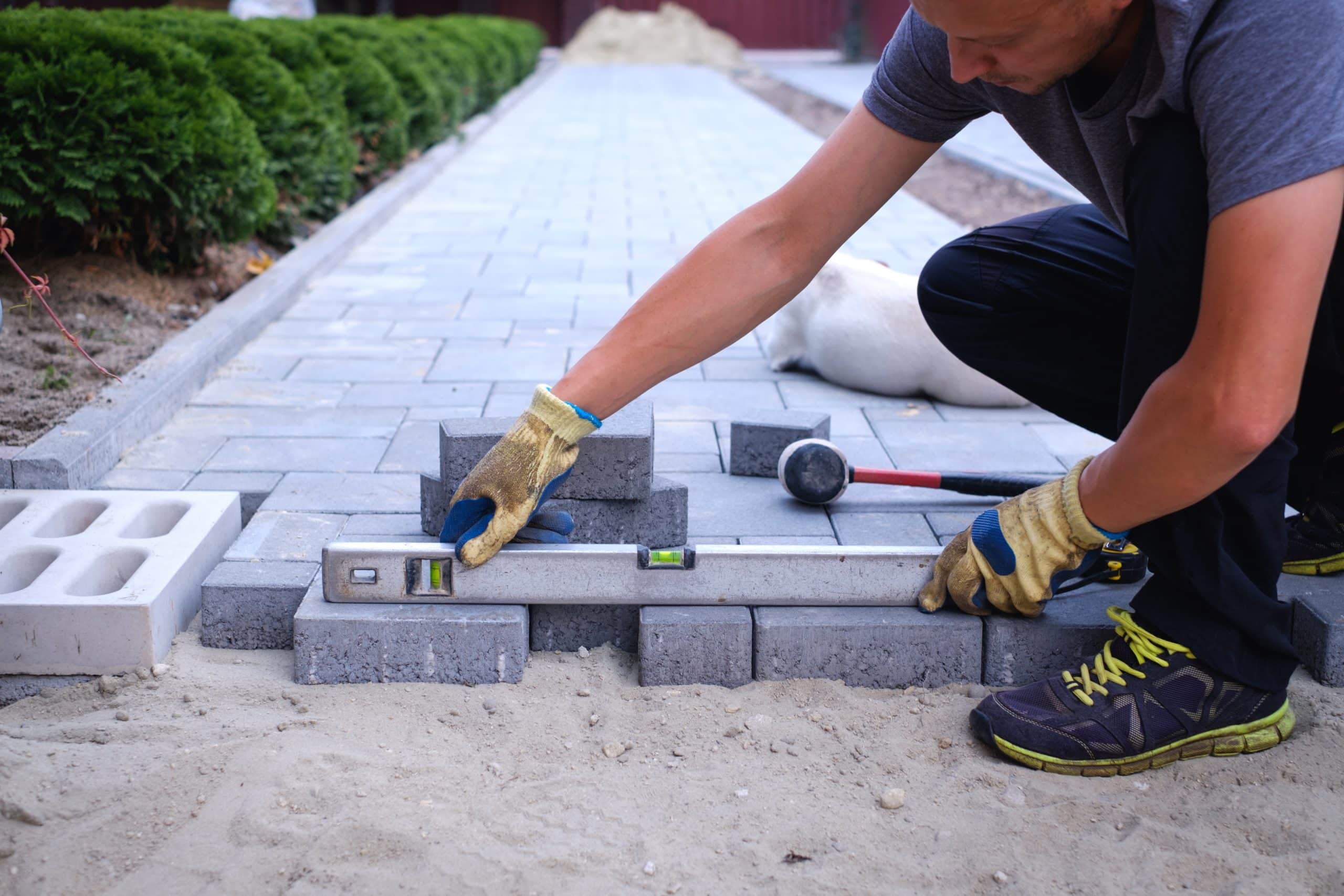
Concrete pavers work differently because they’re not one solid piece. The joints between individual pavers allow the surface to flex slightly with ground movement rather than fighting against it. When the base shifts, individual pavers can move without fracturing. And if a paver does get damaged — cracked by a heavy load, stained beyond cleaning, or just worn unevenly — you can pull that single unit and replace it without touching the rest of the surface. That’s a repair you can do for the cost of a few pavers, not the cost of a full demolition and repour.
There’s also the salt factor. Nassau County homeowners use deicing products heavily, and municipalities salt the roads throughout winter. Sodium chloride and calcium chloride both accelerate concrete surface deterioration — the technical term is scaling, but in plain terms, the surface starts to flake and pit. Quality concrete pavers, particularly those built with a dense surface layer technology like Nicolock’s Paver-Shield™, are significantly more resistant to this kind of damage. The surface density that makes them hold color also makes them hold up better against the chemical exposure that comes with every Long Island winter.
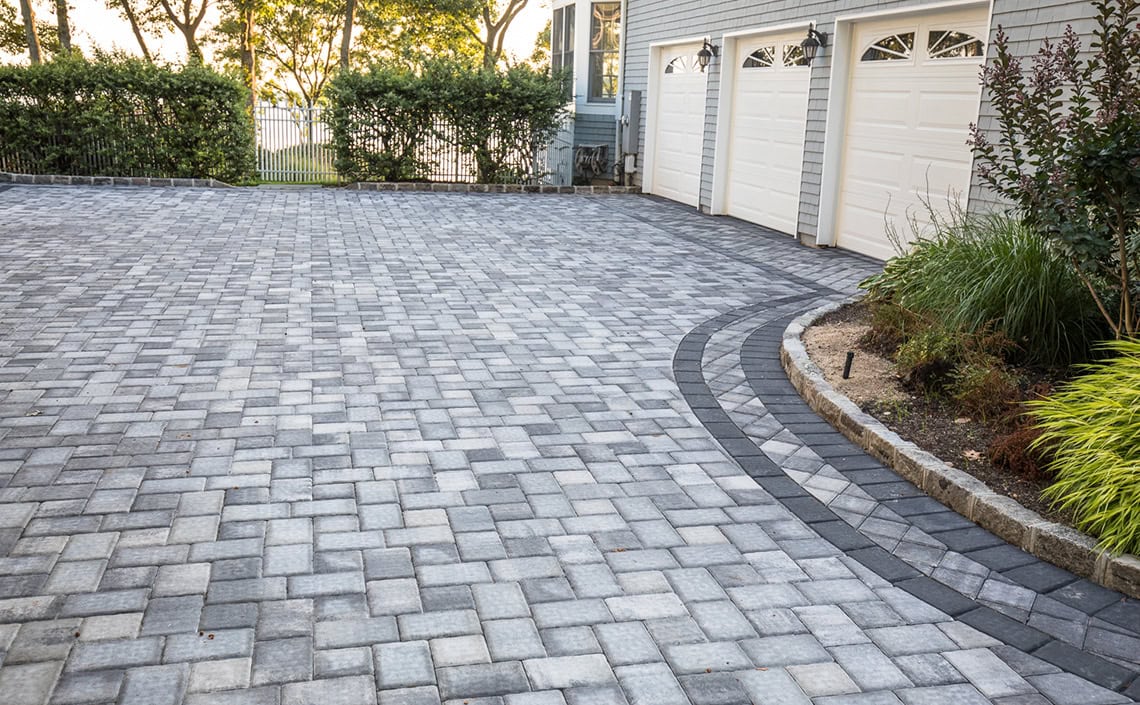
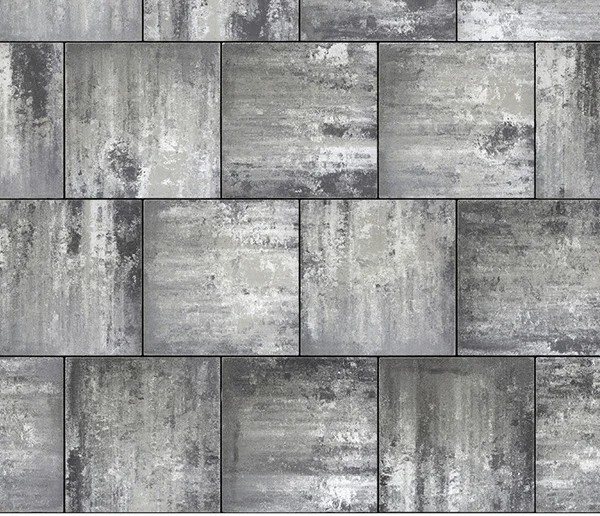
If you’ve been browsing paver options online or walking through a showroom, you’ve probably noticed that the old-school brick-format paver isn’t the only game in town anymore. Large-format concrete pavers — particularly 24×24 slabs — have become increasingly popular for patios because of the clean, contemporary look they create. Fewer joints mean a more seamless surface, and the larger scale tends to make smaller patios feel more open and cohesive.
That said, 24×24 concrete pavers come with some practical considerations worth knowing before you commit. Because each unit covers more surface area, base preparation becomes even more critical. Any inconsistency in the compacted gravel sub-base will show up as an uneven surface more obviously than it would with smaller pavers. This is one of those situations where the quality of the installation matters as much as the quality of the material — and it’s a good reason to work with a contractor who has specific experience with large-format installation.
The weight and handling of 24×24 pavers is also different from standard-sized units. They’re heavier to move and set, which affects both labor time and the equipment a contractor needs on site. For most patios, this isn’t a dealbreaker — it just means the installation is a bit more involved. What you get in return is a surface that looks genuinely custom, holds up well over time when installed correctly, and photographs well if curb appeal or resale value is part of your thinking.
On the style side, large-format pavers work particularly well with modern and transitional home designs — clean lines, neutral color palettes, and minimal joint texture. If your home has more of a traditional or colonial aesthetic (common in many Nassau County neighborhoods built in the postwar era), a standard or cobblestone-format paver might feel more at home. The best way to make that call is to see both options side by side in person, which is exactly what our Roslyn Heights showroom is set up for.
Want live answers?
Connect with a Powerhouse Mason Supply expert for fast, friendly support.
Natural stone pavers — bluestone, travertine, marble, limestone — occupy a different part of the market than manufactured concrete products. They’re not better or worse in any universal sense; they just perform differently and suit different priorities. If you’re designing a high-end outdoor living space on the North Shore and you want a surface that looks genuinely unique, natural stone has an aesthetic that manufactured concrete can approximate but not fully replicate.
The tradeoffs are real, though. Natural stone is more porous than most concrete pavers, which means it absorbs more moisture and generally requires sealing every one to two years to protect against weathering and staining. The variation that makes natural stone beautiful — the color shifts, the veining, the texture differences from piece to piece — also means that matching a repair or addition years later can be difficult. And in Nassau County’s climate, some natural stones (particularly marble and certain limestones) require more careful maintenance to avoid surface damage from freeze-thaw exposure.
This is one of the most common questions we hear, and the honest answer depends on what you mean by “durable.” Concrete pavers — particularly those from established manufacturers like Nicolock and Cambridge — are engineered to meet strict compressive strength standards. Most quality concrete pavers are roughly four times stronger under compressive load than a standard poured concrete slab. They’re manufactured to consistent specifications, which means the product you get from one pallet performs the same as the product from the next.
Natural stone’s durability is more variable because it’s a natural material. Dense stones like bluestone and granite handle Nassau County winters quite well. More porous stones like certain travertines and limestones need more attention — specifically, consistent sealing to prevent moisture infiltration and the freeze-thaw damage that follows. This isn’t a reason to avoid natural stone; it’s just a reason to go in with clear expectations about what the maintenance commitment looks like over time.
From a practical maintenance standpoint, both material types benefit from polymeric sand in the joints — a hardened joint filler that resists weed growth and ant intrusion — and periodic resealing to protect the surface. The difference is that with concrete pavers, you’re mostly protecting against staining and minor surface wear. With natural stone, you’re also protecting against moisture absorption that can cause real structural damage in a cold climate. Neither is particularly burdensome maintenance, but it’s worth knowing what you’re signing up for before you choose.
One thing that often gets overlooked in these comparisons is what happens when something goes wrong. With concrete pavers, a single damaged unit can be pulled and replaced. With natural stone, the challenge is finding a replacement piece that matches the color and texture of the original installation — especially years later when the existing stone has weathered and the available inventory has changed. This is a real practical consideration for anyone planning a long-term outdoor space, not just a hypothetical.
**Do concrete pavers crack in cold weather?**
Quality concrete pavers handle Nassau County winters significantly better than poured concrete because of how the interlocking system works. The joints between pavers allow for micro-movement during freeze-thaw cycles rather than forcing the surface to absorb all the stress as a rigid slab would. That said, the base preparation underneath the pavers is what really determines how the surface performs over time. A properly compacted gravel sub-base with adequate depth is what prevents the settling and shifting that leads to surface problems. This is why installation quality matters as much as material quality — a good paver installed on a poor base will still develop issues.
**How long do concrete pavers actually last?**
Properly installed concrete pavers typically last 50 years or more. Poured concrete, by comparison, generally needs replacement after 30 to 40 years — and that’s under normal conditions, not accounting for the accelerated wear that comes with Nassau County’s freeze-thaw cycles and salt exposure. The longer lifespan of pavers, combined with the ability to repair individual units rather than replacing the entire surface, means the total cost of ownership over a 20- or 30-year window often favors pavers even though the upfront cost is higher.
**Can I buy pavers for a small repair without ordering a full pallet?**
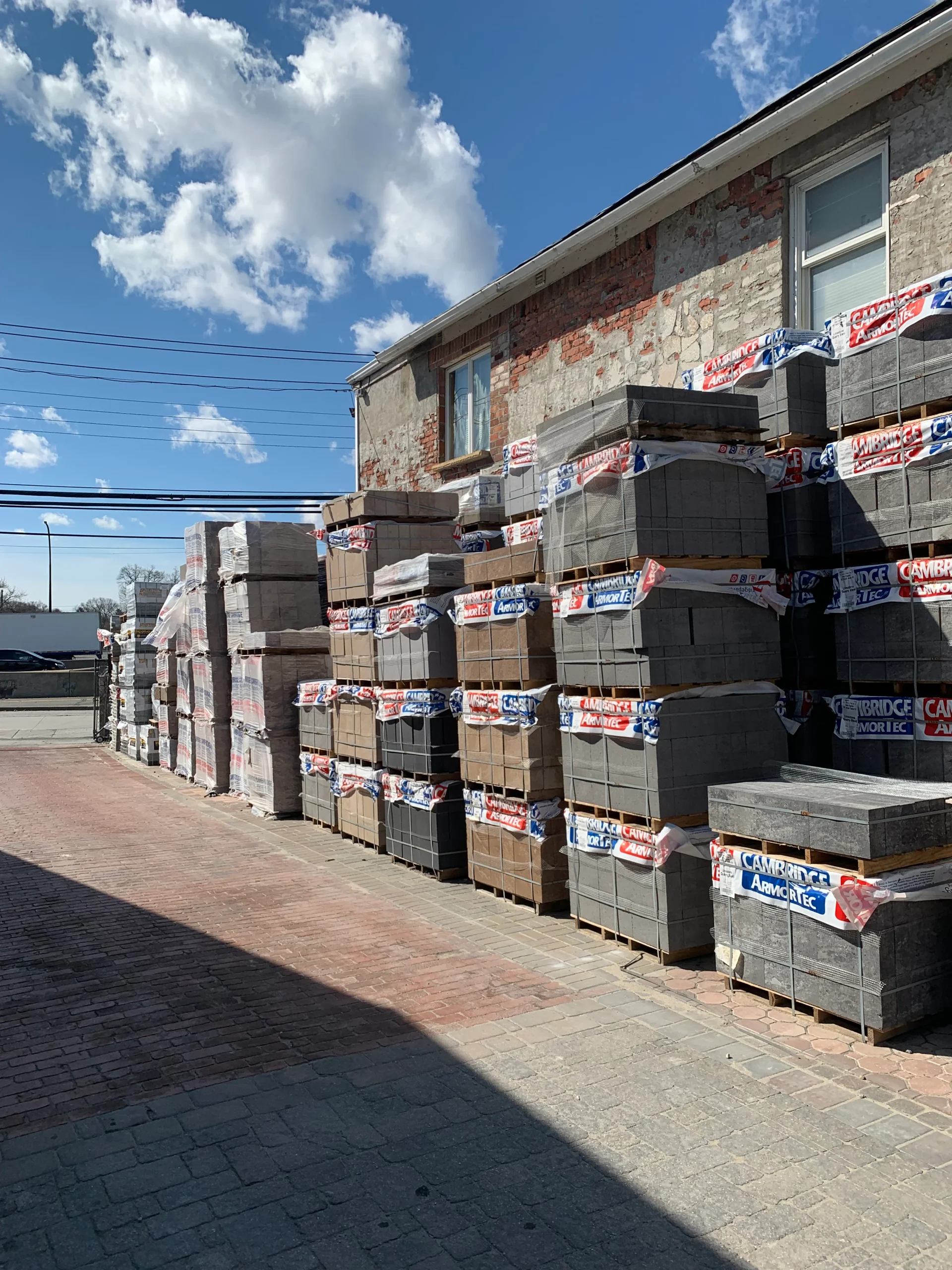
Yes — and this matters more than most people realize. Most masonry suppliers require full-pallet minimums, which creates a real problem for homeowners who need to replace a handful of damaged pavers or add a small extension to an existing patio. We’re able to break pallets for customers who need smaller quantities, which means you’re not stuck buying far more material than your project requires.
**Do I need a licensed contractor to install pavers in Nassau County?**
Paver installation contractors in Nassau County are required to hold a Nassau County Home Improvement License — commonly referred to as an H-license. Before signing any contract, it’s worth asking your contractor to show their license number. If they can’t produce it, that’s a meaningful red flag in a market where installation quality varies widely. We connect customers with experienced local Long Island contractors, so if you’re not sure where to start, that’s a conversation we’re happy to have.
**What’s the difference between patio stone and concrete pavers?**
“Patio stone” is a broad term that can refer to either natural stone products (bluestone, travertine, limestone, marble) or manufactured concrete pavers. They look different, perform differently in Nassau County’s climate, and have different maintenance requirements. The short version: concrete pavers are more consistent and generally more forgiving in cold-weather climates; natural stone offers a unique aesthetic that manufactured products can approximate but not exactly replicate. The right choice depends on your priorities, your budget, and how much maintenance you’re willing to do over time.
The concrete pavers versus poured concrete decision comes down to one question more than any other: what do you want this surface to look like in 20 years? Poured concrete is a reasonable material in moderate climates with stable soil. Nassau County is neither of those things. The freeze-thaw cycles, the salt exposure, the mature tree canopy pushing roots under aging slabs — all of it stacks the deck against a monolithic concrete surface in ways that aren’t always obvious until the damage is already done.
Concrete patio pavers aren’t a premium option for the sake of appearances. They’re an engineering solution to a specific set of conditions that Long Island homeowners deal with every single winter. The repairability, the strength, the surface technology in products like Nicolock’s Paver-Shield™ and Cambridge’s ArmorTec — these aren’t marketing claims. They’re the reason properly installed pavers outlast poured concrete by a decade or more in climates like ours.
If you’re ready to see the options in person, Powerhouse Mason Supply has showrooms in Roslyn Heights and Amityville where you can compare products side by side before making any decisions. And if you’re not sure where to start, our team can help you figure out what makes sense for your specific project — and connect you with a trusted local installer once you’re ready to move forward.
Article details:
Share:
Continue learning: