Nassau County driveways are getting a rethink. Here's what grass pavers actually are, why they're gaining ground on Long Island, and what you need to know before your next project.
Share:
Summary:
If your driveway is cracked, stained, and overdue for replacement, you’ve probably already started Googling. And if you’ve been defaulting to asphalt quotes or standard concrete pavers, that’s completely understandable — they’re familiar, they’re available, and every contractor on Long Island installs them. But there’s a whole category of driveway material that most Nassau County homeowners have never seriously considered, not because it doesn’t work, but because nobody’s explained it yet.
Grass paver driveways are one of those options. Here’s what they actually are, how they perform in a Long Island climate, and why more homeowners in Roslyn, Garden City, and Manhasset are starting to take them seriously.
A grass paver driveway is exactly what it sounds like — a driveway surface made up of individual paver units with open cells or gaps that allow grass to grow through. The pavers themselves provide the structural load-bearing surface for vehicles, while the open areas let rainwater pass through the ground below and allow grass to establish naturally.
There are two main material types. Concrete lattice pavers, like Nicolock’s Turfstone, are made from solid concrete with roughly 40% of their surface left open. Plastic geocell systems use a honeycomb-style grid that’s filled with soil and seeded. Both work on the same principle — a hard, stable grid that carries vehicle weight, with living green filling the gaps.
The result looks far less like a parking lot and far more like a lawn that happens to be driveable.
Here’s the thing about Nassau County that doesn’t come up enough in generic paving content: the ground beneath your driveway matters in a way it doesn’t in other parts of the country. Long Island sits on top of a sole-source aquifer system — the primary drinking water supply for the entire island.
When rain hits an impervious driveway surface, it runs off into storm drains rather than soaking back into the ground. Do that across enough driveways, parking lots, and rooftops, and you’re slowly reducing the groundwater recharge that keeps that aquifer healthy.
Grass paver driveways flip that equation. Concrete lattice pavers like Turfstone allow rainwater to return to the soil directly, rather than routing it into the municipal stormwater system. That’s not a marketing talking point — it’s the core engineering principle behind permeable paving. And in Nassau County specifically, where South Shore communities are still dealing with the drainage realities exposed by Hurricane Sandy in 2012, the idea of a driveway that actively manages water rather than redirecting it carries real weight.
This is also why Nassau County and other Long Island municipalities are increasingly paying attention to impervious surface coverage. Homeowners who install permeable driveways may find themselves ahead of regulatory trends rather than scrambling to catch up with them. Some regions already offer tax benefits or rebates for sustainable landscaping solutions — worth looking into before you finalize any driveway project.
The drainage benefit isn’t abstract. If you’ve ever watched water pool at the base of your driveway after a heavy rain, or watched runoff carve channels through your lawn, a grass paver system addresses that at the source. The water goes down, not sideways.
This is the first question most Nassau County homeowners ask once they start warming up to the idea. And it’s a fair one. Long Island winters aren’t brutal by upstate standards, but temperatures regularly drop below freezing from December through February, and freeze-thaw cycles are a real factor in how any driveway surface performs over time.
Here’s the honest answer: concrete lattice grass pavers handle freeze-thaw movement better than monolithic concrete slabs. The reason is structural. A solid concrete driveway is one continuous surface — when the ground beneath it shifts through repeated freezing and thawing, the slab cracks across its length. Segmented paver units, by contrast, can flex micro-fractionally at their joints without fracturing.
That’s why you see 20-year-old paver driveways on Long Island that still look clean, while similarly aged concrete slabs are riddled with cracks.
Snow removal does require some care. Metal-bladed plows can damage the grass growing in the open cells. Rubber-edged plows or hand shoveling is the recommended approach, and it’s worth discussing this with your installer before the first winter. It’s a real consideration, not a dealbreaker — but it’s worth knowing upfront rather than finding out in January.
One more thing: the grass in the open cells doesn’t require a different lawn care regimen than your existing lawn. You mow at normal height for your grass variety. The concrete structure sits below the blade, so your mower won’t contact it. The maintenance conversation is simpler than most homeowners expect.
Want live answers?
Connect with a Powerhouse Mason Supply expert for fast, friendly support.
Grass pavers are the emerging option, but brick paver driveways are still the most requested driveway upgrade on Long Island — and for good reason. A well-installed brick paver driveway can last 30 to 50 years with proper maintenance, it handles Long Island’s freeze-thaw cycles well for the same segmented-unit reasons, and it offers a level of design flexibility that poured concrete simply can’t match.
What’s changed is how homeowners are using brick pavers. The all-brick field driveway is still popular in towns like Hewlett-Woodmere, Oyster Bay, and Great Neck, where traditional curb appeal is a priority. But increasingly, homeowners are combining brick pavers with other materials — grass paver sections along the edges, driveway tile accents at the apron, or natural stone borders — to create something that reads as genuinely designed rather than default.
If brick pavers are the Long Island classic, large-format driveway tile is where the higher-end market is moving. Porcelain driveway tile — typically in large, clean-edged formats — has been gaining traction in Nassau County’s more design-conscious neighborhoods, particularly in areas like Manhasset and Roslyn where homeowners are paying close attention to architectural coherence between the home’s exterior and its hardscape.
The appeal is straightforward. Porcelain pavers offers a contemporary, low-profile look that reads more like an extension of the home’s design than a utilitarian driveway surface. It’s dense, frost-resistant when properly specified, and holds color well over time without the fading that can affect some concrete paver products.
Large-format tile requires a very stable, well-prepared base — more so than standard pavers — and installation demands a higher level of skill. It’s not the right choice for every property or every budget. But for homeowners who want something that looks genuinely different from every other driveway on the block, it’s worth understanding as an option.
What’s interesting is how driveway tile, brick pavers, and grass pavers are increasingly showing up in the same project. A common approach in higher-end Nassau County renovations is a brick paver field with a large-format tile apron at the street, or a grass paver border along the lawn edge with a tile or natural stone center strip. The materials work together when they’re chosen thoughtfully — and that’s where having access to a full range of products in one place makes a real difference.
Bluestone has been a Long Island staple for decades — you see it on patios, pool surrounds, walkways, and front stoops from Valley Stream to Oyster Bay. It has a natural, slightly irregular surface character that pairs well with both traditional and transitional architecture, and it holds up well in the Long Island climate when properly installed.
What’s newer is how homeowners are incorporating bluestone patio pavers as accent elements within driveway designs rather than treating driveways and patios as entirely separate projects. A bluestone border along the edges of a brick paver driveway, for example, creates a clean visual frame that ties the driveway to the landscaping. Bluestone step inserts at the garage apron or front entry add a natural stone moment that elevates the overall design without requiring a full natural stone driveway — which carries a significantly higher material cost.
The combination of grass pavers, brick pavers, and bluestone accents is becoming one of the more distinctive driveway design approaches on Long Island right now. It reflects a broader shift away from single-material driveways toward something that reads as intentionally designed. Homeowners in competitive real estate markets like Nassau County, where curb appeal has a direct impact on home value and time-on-market, are paying attention to this in a way they weren’t five years ago.
The key to making mixed-material driveways work is material selection that coheres — colors, textures, and scales that complement rather than compete. That’s a conversation worth having before you commit to anything, ideally with someone who can show you the actual materials side by side.
The driveway conversation has gotten more interesting on Long Island. Grass pavers, brick pavers, driveway tile, and bluestone accents aren’t competing options so much as a palette — and the homeowners getting the best results are the ones who understand what each material actually does before they start getting quotes.
If you’re in the early stages of figuring this out, the most useful thing you can do is see the materials in person. Photos online don’t tell you how a product feels underfoot, how the color holds in different light, or how two materials look sitting next to each other. That’s where a showroom visit changes the conversation.
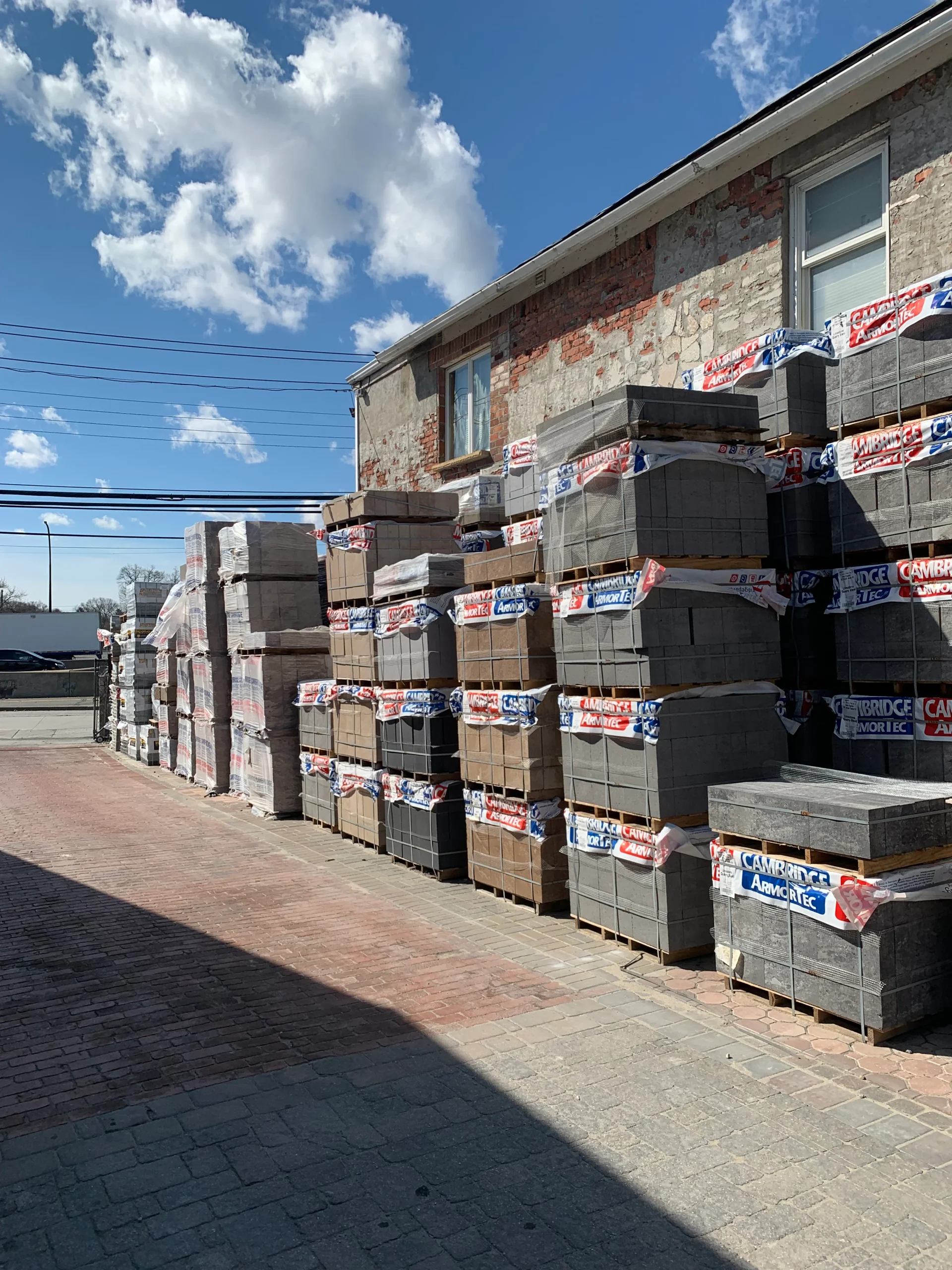
We at Powerhouse Mason Supply carry Nicolock’s full permeable paver line — including Turfstone — along with Cambridge Pavers, natural stone, porcelain tile, and bluestone products across our three Long Island locations. Our Roslyn Heights showroom is right here in Nassau County. If you’re not sure where to start, come in and we’ll walk you through it — and if you need a contractor, we can connect you with experienced local installers who know this material and this market.
Article details:
Share:
Continue learning: