The fall installation window in Nassau County is shorter than most people realize. Here's what you need to know before it closes.
Share:
Summary:
If you’ve been watching a retaining wall lean a little more each spring, or you’ve got a contractor lined up and materials still unordered, this is the moment that matters. Nassau County’s freeze-thaw season doesn’t negotiate. Once the ground hardens — typically late November — installation stops, and whatever you didn’t finish gets pushed into next year’s backlog. The good news is that if you move now, there’s still time to get the right large retaining wall block sourced, delivered, and installed before the season closes. Here’s what you need to know to make that happen.
Not every retaining wall block is built for Nassau County’s conditions. The North Shore — communities like Roslyn, Old Westbury, Brookville, and Sands Point — deals with real grade changes, slopes, and bluffs where a wall isn’t decorative, it’s structural. Add in 20 to 35 freeze-thaw cycles per winter and you’ve got a climate that will find every weakness in a poorly engineered system within a few years.
The retaining wall systems that hold up here are engineered for exactly this kind of stress. Nicolock’s Alta Pro Wall uses 8-inch blocks — two inches taller and wider than the standard Alta Wall — specifically designed for large-scale tiered walls, elevated seating areas, and high-load applications where structural integrity isn’t optional. The rear lip connection system locks each course in place, and the one-inch setback per row creates a natural slope that manages pressure from the soil behind it.
For larger gravity-wall applications, REDI-ROCK systems take a different approach entirely — massive precast blocks where the weight of the material itself is the primary structural force. These aren’t landscape garden blocks. They’re engineered for serious soil retention, and we stock them at our Roslyn Heights location for Nassau County customers.
A lot of Nassau County homeowners come to us planning one project and realize they’re actually planning two. A sloped yard that needs a retaining wall often connects directly to a driveway or walkway that needs regrading or new paving. It’s worth thinking about both together — not because it means spending more, but because coordinating materials and contractor scheduling in one fall window is far more efficient than doing each project in separate seasons.
On the retaining wall side, large concrete retaining wall blocks typically run $25 to $100 per block depending on size, while interlocking concrete blocks used in segmental wall systems run $2 to $10 per block for materials. Installed retaining walls average $3,000 to $10,000 depending on wall height, length, and complexity, with contractors in Nassau County typically charging $50 to $75 per hour or $15 to $50 per square foot for this type of work.
Block paving for driveways and walkways is a separate line item, but the same principle applies: material costs vary significantly based on product, and sourcing from a single supplier who carries both wall systems and paving products simplifies the entire process. We carry Cambridge Pavers, Nicolock, and a range of natural stone and porcelain options — so if your project touches both a retaining wall and a paved surface, you’re not making two separate trips to two separate yards.
The more important point for fall planning is this: contractor schedules in Nassau County fill up fast once October arrives. If you’re coordinating a wall and a driveway in the same project, getting your materials confirmed and your contractor locked in now is the difference between finishing before Thanksgiving and waiting until April.
This is one of the most common questions we hear, and it’s worth addressing directly because the answer affects your timeline more than almost anything else. In most Nassau County municipalities, retaining walls above four feet in height — measured from the bottom of the footing — require a building permit and, in many cases, a licensed engineer’s stamp on the design. That’s not a suggestion. It’s code.
If your wall is under four feet and you’re working with a straightforward interlocking block system, you may be able to proceed without a permit depending on your specific municipality. But for any large retaining wall block project — especially on the graded, sloped properties common on Nassau County’s North Shore — you should check with your local building department before breaking ground. We’re a supply yard, not a code authority, so we’re not the right source for a definitive answer on your specific address. What we can tell you is that the homeowners who run into the worst delays are the ones who start ordering materials before they’ve confirmed their permit status.
The practical implication for fall planning is straightforward: permit applications take time, and Nassau County building departments get busy in September and October as contractors rush to close out the season. If a permit is required for your project, starting that process now — before you’re ready to order — is the move. By the time approval comes through, you’ll have your materials confirmed and your contractor scheduled, and you’ll be able to move immediately rather than waiting in line.
One more thing worth knowing: walls over four feet typically require geogrid reinforcement layers built into the installation. That’s a material consideration, not just a structural one. If your contractor is specifying geogrid, make sure your supplier can provide it alongside your block order. We stock the aggregates, drainage materials, and accessory products that proper wall installation requires — not just the blocks themselves.
Want live answers?
Connect with a Powerhouse Mason Supply expert for fast, friendly support.
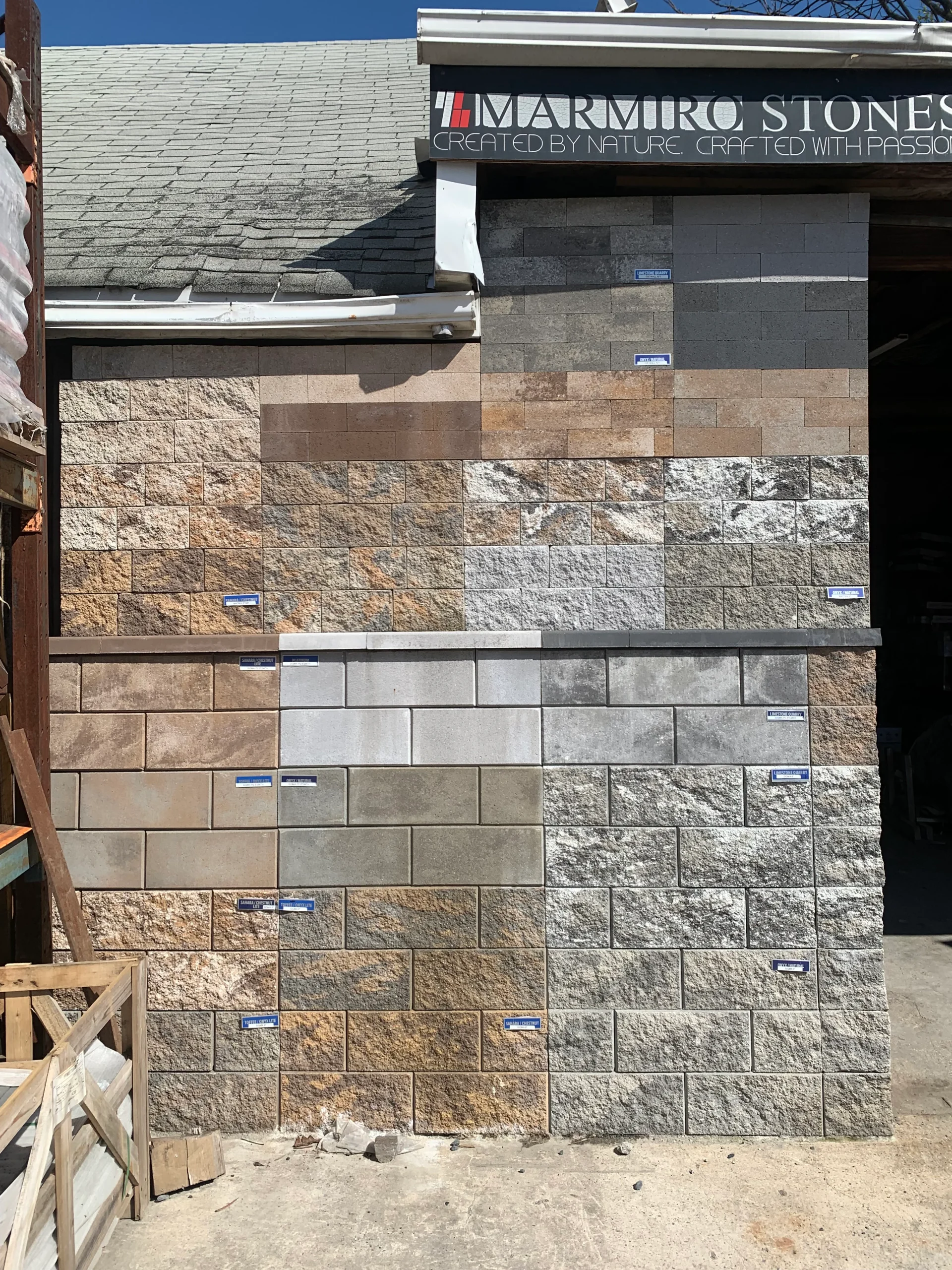
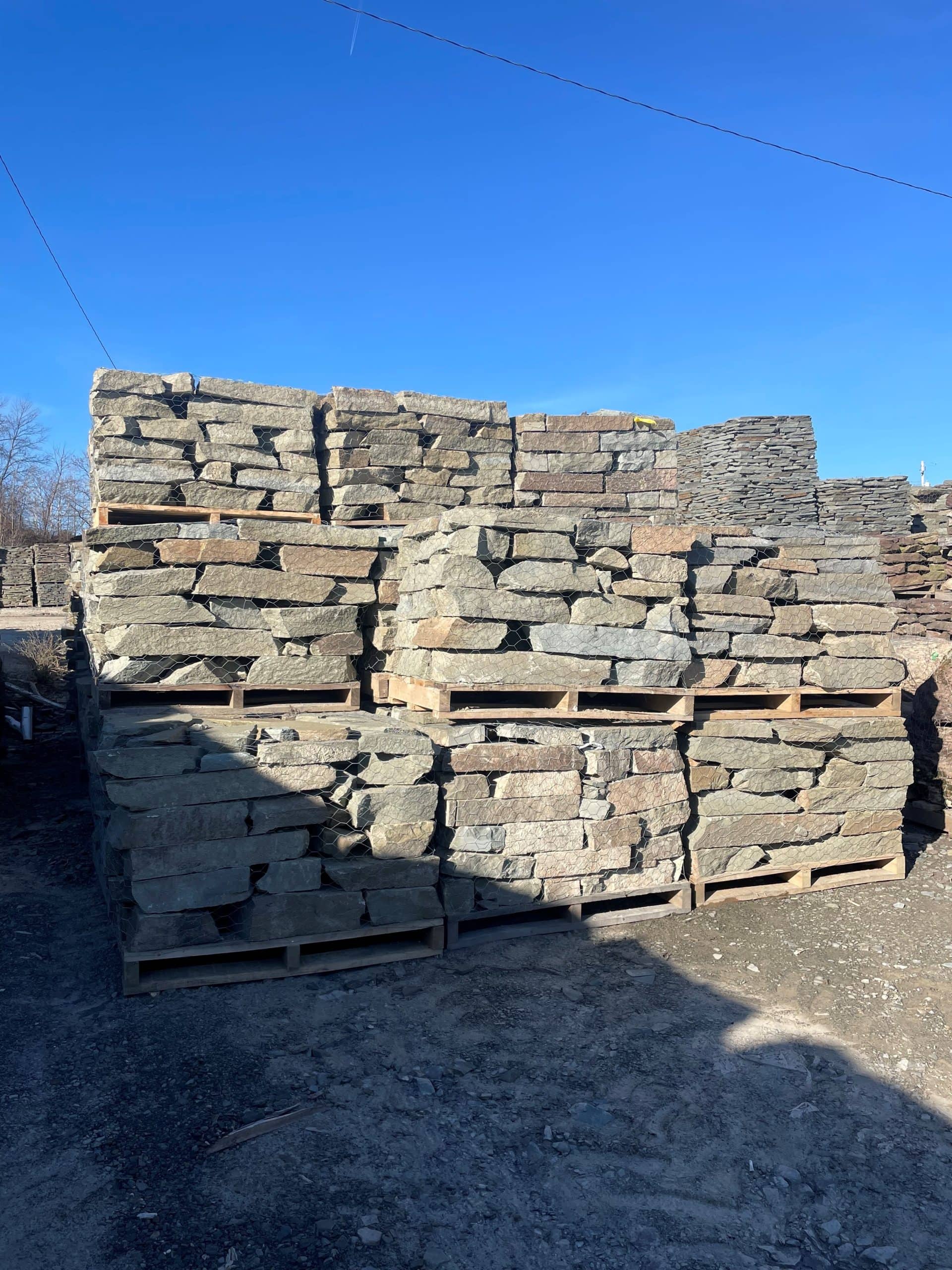
The term “large retaining wall block” covers a wide range of products, and understanding the difference matters before you order. Interlocking retaining wall blocks — segmental systems like the Nicolock Alta Wall, Kodah Wall, Verona Wall, and Colonial Wall — use engineered geometry and connection systems to create stability through interlocking rather than sheer mass. These are the systems most residential contractors in Nassau County reach for on sloped yard projects, tiered garden walls, and elevated outdoor living spaces.
Large gravity blocks like REDI-ROCK take the opposite approach: the blocks themselves are massive — ranging from 2x2x2 feet up to 6x2x2 feet — and the wall holds because of weight alone. These are used for commercial-scale applications and major residential grade changes where a segmental wall wouldn’t provide adequate retention on its own.
Knowing which category your project falls into shapes everything from material cost to contractor selection to permit requirements.
The most common reason retaining walls fail in Nassau County has nothing to do with the block itself. It’s drainage. Water that can’t escape the soil behind a retaining wall builds hydrostatic pressure — and over 20 or 30 freeze-thaw cycles, that pressure will move even a well-installed wall. Proper backfill drainage, typically crushed gravel aggregate packed behind the wall, is what separates a wall that lasts 30 years from one that starts leaning after five.
This is something a lot of homeowners don’t hear until after a wall has already failed. The blocks get the attention because they’re visible. The drainage doesn’t, because it’s buried. But the drainage is doing most of the structural work.
For interlocking segmental systems specifically, the installation sequence matters as much as the materials. Each course needs to be level, the base needs to be properly compacted, and for walls over three to four feet, geogrid reinforcement layers need to be incorporated at the right intervals. Nicolock’s Alta Pro, for example, is engineered with a rear lip connection system that ensures each block locks to the course below it — but that engineering only works if the installation follows the design specifications.
We carry the aggregates and drainage materials alongside our wall block inventory, which means your contractor doesn’t have to source those separately. That coordination matters more than it sounds when you’re working against a fall deadline and every extra sourcing step adds days to a schedule that’s already tight.
A significant portion of Nassau County’s retaining walls were built in the 1950s, 1960s, and 1970s — railroad ties, unreinforced block, mortared fieldstone. These materials were never engineered for the freeze-thaw stress Nassau County delivers every winter, and many of them are now at or well past the end of their useful life. If your wall was built before 1990 and you’ve noticed it leaning, cracking, or shifting after winter, you’re not looking at a maintenance issue. You’re looking at a replacement.
The communities where we see this most often are exactly the ones with the most topographic variation — Roslyn, Glen Head, Old Westbury, Brookville, Manhasset, Great Neck. These are North Shore neighborhoods where the land actually moves, where grade changes are real, and where a wall that fails doesn’t just look bad — it can damage driveways, foundations, and neighboring property.
Replacing an aging wall with a properly engineered large retaining wall block system isn’t just about aesthetics. It’s about not doing the project twice. A Nicolock Kodah Wall or Alta Pro installation, done right with proper drainage and geogrid where required, is designed to handle Nassau County’s conditions for decades. The older systems that are failing now weren’t.
The fall window is the last viable installation window before winter, and it’s shorter than most people account for. Contractors are scheduling into October and early November, and once the ground freezes, the season is over. If you’ve been watching a wall and waiting to see if it makes it through another winter, this is the year to stop waiting.
The fall installation window in Nassau County is real, and it closes fast. If your project is planned and your contractor is lined up, the single most important thing you can do right now is confirm that your block is in stock and your delivery is scheduled. Material shortages mid-project — especially for specific block colors and sizes — are one of the most common reasons fall jobs get pushed to spring.
We’ve been in masonry for generations and supplying Long Island and the Boroughs for 25 years. We carry Cambridge and Nicolock wall systems, drainage aggregates, and the accessory materials your contractor needs to do the job right. If you don’t have a contractor yet, we can connect you with experienced installers in the Nassau County area.
Reach out to us at Powerhouse Mason Supply, 85 Powerhouse Rd, Roslyn Heights, NY. We’re open Monday through Friday 7 AM to 5 PM and Saturdays 7 AM to 1 PM. The window is open. Let’s make sure your project gets through it.
Article details:
Share:
Continue learning: