Not all pavers hold up to Long Island winters. Here's how to choose natural stone that lasts — and what to look for before you buy.
Share:
Summary:
If you’ve watched a concrete driveway or patio slowly lose the battle with Long Island winters — cracking, heaving, spalling after a few hard freezes — you already know the frustration. And if you’re now researching natural stone pavers, you’re asking the right question. But not all stone is created equal, and the wrong choice can be just as disappointing as what you’re replacing.
This guide is written specifically for Nassau County homeowners who want to understand what actually works in this climate, what it costs, and how to make a decision you won’t regret in five years.
The simplest way to understand natural stone pavers is to compare them to what most people start with: concrete. Concrete pavers are manufactured — mixed, molded, and cured to a consistent shape and color. Natural stone is quarried directly from the earth, which means no two pieces are identical. That variation is part of the appeal, but it also means natural stone carries structural properties that manufactured materials simply can’t replicate.
Natural stone can handle approximately 8,000 PSI of load stress, compared to roughly 2,000 PSI for unreinforced concrete. For a Nassau County driveway that sees vehicle traffic year-round, that difference is significant. It’s also why quality natural stone installations regularly last 50 years or more, while concrete paver surfaces in freeze-thaw climates often need major repair or replacement within 15 to 20 years.
This is the question that matters most for Long Island homeowners, and the answer comes down to one technical factor: absorption rate. Nassau County experiences repeated freeze-thaw cycles each winter — temperatures dip below freezing, then climb back above it, sometimes multiple times in a single week. When a paving material absorbs water and that water freezes, it expands. Do that enough times and even a well-installed surface starts to crack from the inside out.
Low-absorption natural stones are specifically built to resist this. Granite, for example, has an absorption rate between 0.056% and 0.30%, which is essentially negligible. Water doesn’t get in, so there’s nothing to freeze and expand. Dense limestone and bluestone perform similarly well. These are the stones we’d point you toward first if your primary concern is durability through a Long Island winter — and for most Nassau County homeowners, it should be.
Travertine and slate are also popular choices and handle freeze-thaw conditions reasonably well when properly sealed, but they require more maintenance attention than granite or dense limestone. Travertine in particular is porous, which means sealing isn’t optional — it’s part of the maintenance routine. That’s not a dealbreaker, but it’s something to factor into your decision before you fall in love with a particular look.
Sandstone sits at the other end of the spectrum. It’s beautiful in warmer, drier climates, but its higher absorption rate makes it a poor fit for Nassau County’s winters. We see homeowners make this mistake occasionally — they choose a stone based on how it looks in a showroom without considering how it’ll behave in February. The goal of this guide is to make sure that doesn’t happen to you.
One more thing worth knowing: granite is also the hardest natural stone available, which makes it the top choice for driveways subject to heavy or frequent vehicle loads. If you’re replacing a driveway that’s taken years of punishment, granite is the material that’s most likely to still look good in 30 years.
This isn’t just a sales pitch for visiting a showroom — it’s a genuine limitation of how natural stone works. Unlike concrete pavers, which are manufactured to a consistent color and finish, natural stone varies from slab to slab. A travertine that photographs as warm gold may read as cream or ivory under afternoon light in your backyard. A slate that looks charcoal in a product image may have deep blue or green undertones when you hold it in your hand.
Color is only part of it. Texture, weight, and finish all affect how a stone looks and feels in a real outdoor setting. A honed finish reads very differently from a tumbled or brushed finish — both in appearance and in how the surface performs underfoot when wet. These are distinctions that simply don’t come through on a screen, and they matter enormously when you’re making a decision that’s going to be part of your home for decades.
This is why our Roslyn Heights showroom exists. Homeowners from across Nassau County — from Garden City and Manhasset to Jericho and Old Westbury — come in specifically to compare materials side by side before committing. You can see how different stone types look next to each other, evaluate finishes in real light, and talk through your project with someone who’s helped hundreds of Long Island homeowners make this exact decision. There’s no substitute for that, and no online catalog can replicate it.
The other advantage of an in-person visit is that you can ask questions that don’t have a clean answer online. What’s the right thickness for a patio versus a driveway? Which finish is easiest to maintain? Which stone types pair well together for a walkway-to-patio transition? These are the kinds of details that make a project look intentional rather than assembled — and they’re exactly what our team is there to help you work through.
Want live answers?
Connect with a Powerhouse Mason Supply expert for fast, friendly support.
Concrete pavers have improved significantly over the years, and we carry them — Cambridge Pavers and Nicolock are both part of our inventory. They’re a legitimate choice for certain applications, and we’re not going to tell you otherwise. But there are situations where natural stone is clearly the better call, and understanding the difference helps you make a decision based on your actual priorities rather than just price.
The most honest comparison comes down to longevity and appearance over time. Concrete pavers fade, and they do it unevenly. After several years of UV exposure and freeze-thaw cycling, the surface color shifts — and if you ever need to replace a section, matching the weathered color of existing pavers is notoriously difficult. Natural stone doesn’t have this problem. It ages in a way that actually enhances its character, developing a patina that looks more settled and intentional over time, not less.
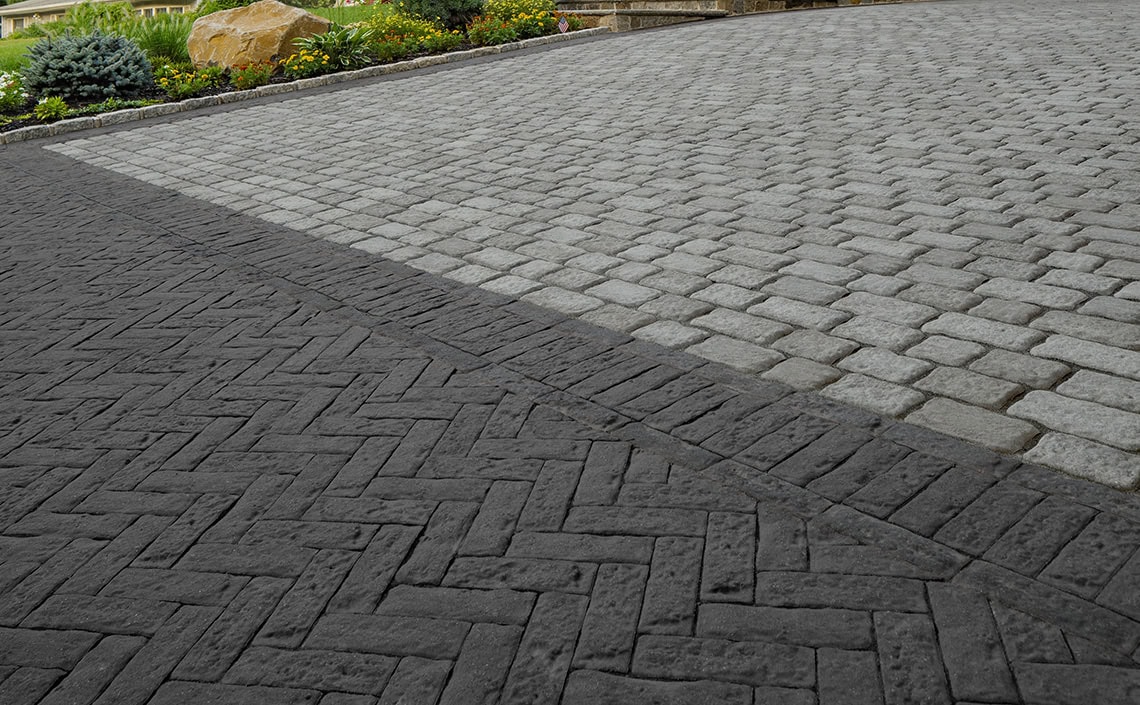
Cost is almost always part of this conversation, and it’s worth being straightforward about it. Natural stone pavers cost more upfront than concrete pavers. For materials alone, natural stone typically runs $12 to $30 or more per square foot depending on the stone type and finish. Fully installed, a natural stone patio or driveway in the Nassau County market generally runs $40 to $50 per square foot.
A 400-square-foot patio in natural stone typically comes in between $16,000 and $20,000 installed, compared to $10,000 to $14,000 for the same size in concrete pavers. That gap is real, and we’re not going to minimize it.
But there’s a second number that matters just as much: replacement cost. If a concrete paver surface needs major repair or replacement after 15 years — which is common in Long Island’s freeze-thaw climate — you’re looking at $6 to $20 per square foot to renovate, on top of whatever you spent originally. A natural stone installation that lasts 50 years doesn’t have that second bill. When you run the math over a realistic time horizon, the cost difference narrows considerably.
There’s also the Nassau County real estate angle. Median home values in this market consistently exceed $600,000 to $700,000 for single-family homes, and curb appeal is a real factor in how buyers perceive a property. Homeowners can expect more than 80% cost recovery on a professionally installed patio. In communities like Garden City, Manhasset, and Great Neck — where outdoor spaces are part of how a home presents itself — the premium appearance of natural stone carries weight that concrete pavers simply don’t.
If you’re replacing an existing surface rather than starting from scratch, the calculus is similar. Patching or resetting sections of a failing concrete paver installation is a short-term fix. Replacing it with the right natural stone is a decision you make once and don’t revisit for a generation.
One of the most common frustrations we hear from Nassau County homeowners isn’t about choosing the wrong stone — it’s about finding a reliable contractor to install it. The demand for quality hardscape installers on Long Island is high, and booking windows during peak season (spring through early fall) can stretch four to eight weeks. If you’ve ever lined up a contractor only to have them go quiet, or gotten three wildly different quotes with no clear explanation for the difference, you know exactly what we’re talking about.
We’ve built a contractor referral network specifically to address this. When you source your materials through us, we can connect you with experienced local Long Island installers who we know and trust — people who’ve worked with our products, understand how to handle natural stone properly, and have a track record in this market. It closes the gap between choosing your material and actually getting the project done, which is often the hardest part of the whole process.
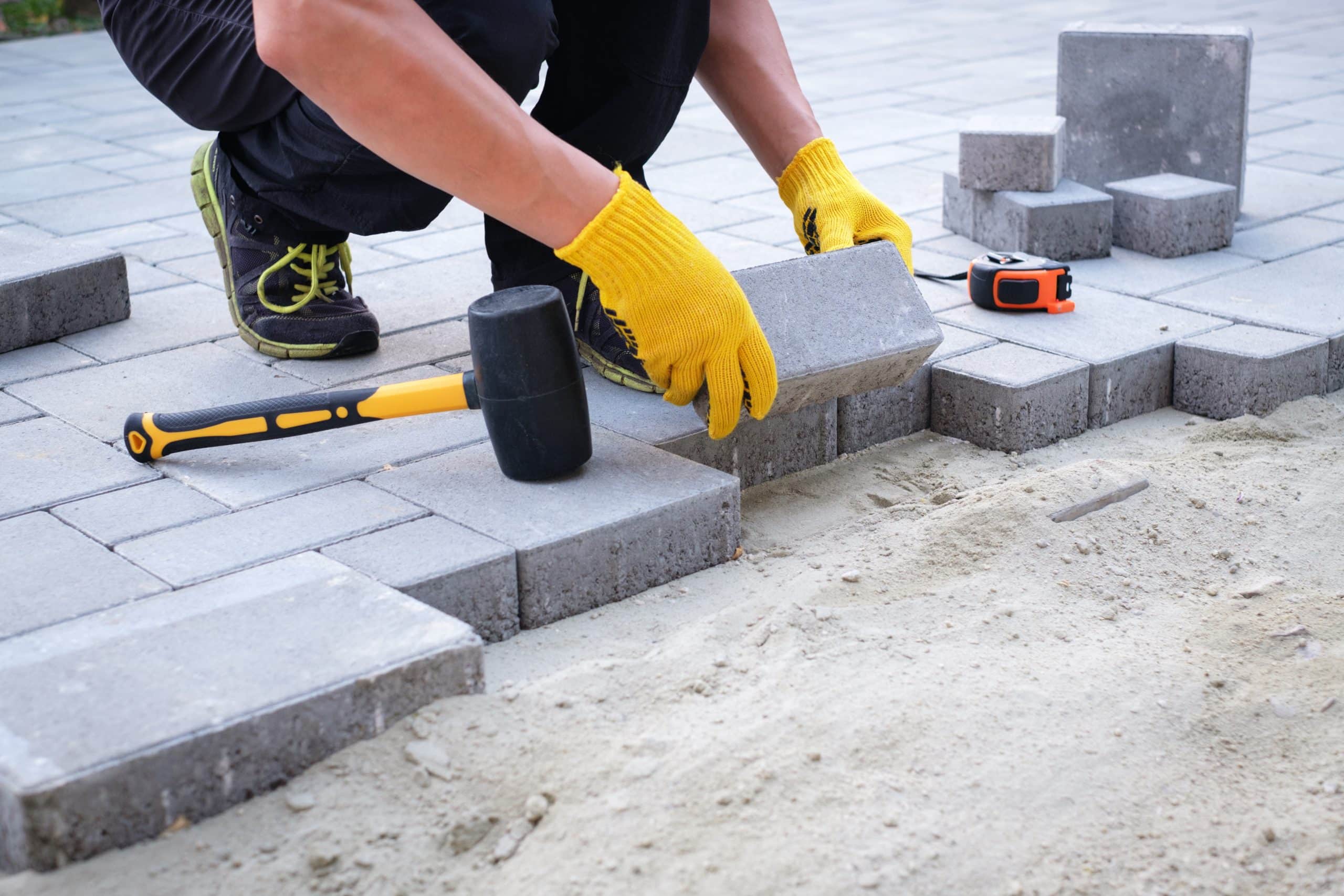
The installation side matters more than most homeowners realize. The most important factor in how long a paver installation lasts isn’t the stone itself — it’s the base preparation underneath it. A properly compacted, well-drained base (typically four to six inches of compacted gravel for patios, more for driveways) is what keeps pavers from sinking, shifting, or allowing water to pool beneath the surface. An experienced installer knows this. A less experienced one might not.
We’re also one of the few suppliers in Nassau County who will break a pallet for smaller residential jobs. Most masonry yards require full-pallet purchases, which means homeowners doing a smaller patio, a walkway repair, or a targeted replacement end up over-buying or compromising on material choice to hit a minimum. If your project doesn’t need a full pallet, you shouldn’t have to buy one.
The short version: match the stone to your climate first, your application second, and your aesthetic third. For Nassau County, that means starting with low-absorption stones — granite, dense limestone, bluestone — that are built to handle freeze-thaw cycling without degrading. From there, consider how the surface will be used (foot traffic only, or vehicles too?), what finish works for your setting, and what maintenance commitment you’re actually willing to make.
The longer version is a conversation worth having in person. Natural stone isn’t a category where photos and spec sheets tell the whole story — the material has to be seen and evaluated in context. If you’re in the early stages of planning a patio, driveway, walkway, or pool deck project in Nassau County, Powerhouse Mason Supply is a good place to start.
Our Roslyn Heights showroom is open Monday through Friday, 7 AM to 5 PM, and Saturdays from 7 AM to 1 PM. Come in, see what we carry, and let’s figure out what actually makes sense for your project.
Article details:
Share:
Continue learning: