Not all patio stone survives a Long Island winter near the water. Here's how to choose the right material before you commit.
Share:
Summary:
Most patio guides treat material selection like a design quiz. Pick your style, pick your budget, done. But if you live in Nassau County — especially anywhere near the South Shore or the North Shore waterfront — the conversation starts somewhere else entirely.
Your patio has to survive two things most inland buyers never deal with at the same time: repeated freeze-thaw cycles every winter and salt air that quietly works its way into porous stone surfaces year-round. That combination changes which materials make sense and which ones look fine in photos but start showing wear faster than they should.
Here’s what you actually need to know before making a decision.
Bluestone has been the go-to natural stone for patios across the Northeast for a long time, and there’s a practical reason for that. It’s quarried primarily in Pennsylvania, New York, and Connecticut — the same region that deals with the same winters. Its density (roughly 150 pounds per cubic foot) and low porosity give it strong resistance to the freeze-thaw cycle, which is the single biggest threat to outdoor hardscape in Nassau County.
Nassau County averages somewhere around 20 to 30 freeze-thaw cycles per winter. That’s 20 to 30 times water is working its way into any micro-pores in your patio surface and expanding as it freezes. Stone that handles this well stays intact for decades. Stone that doesn’t starts spalling and cracking within a few seasons — sometimes sooner.
Bluestone handles it well. That’s why we recommend it for Long Island landscaping, and it’s why contractors who’ve been working in Nassau and Suffolk County for years keep coming back to it.
When you start researching blue stone paver options and get into the details, finish type is one of the first things that comes up — and it’s worth understanding before you visit our showroom or talk to a contractor.
Natural cleft bluestone has the texture you’d recognize from traditional patios and garden paths. The surface is irregular, slightly rough, and has a character that changes from stone to stone. That texture is also functional — it provides excellent traction even when wet, which matters for patios exposed to rain, sprinklers, or pool splash. If you have kids running barefoot or elderly family members who use the patio regularly, that slip resistance is worth noting.
Thermal bluestone goes through a heat treatment process that opens up the surface slightly and gives it a more uniform, flatter appearance. It’s still textured enough to be non-slip, but the look is cleaner and more contemporary. Some homeowners in Nassau County’s North Shore communities — Great Neck, Sands Point, Manhasset — lean toward thermal finish because it pairs well with the more modern architectural styles common in those neighborhoods.
In terms of material cost, natural cleft typically runs $6 to $11 per square foot, and thermal finish runs closer to $9 to $14 per square foot. Installed, a bluestone patio averages $15 to $31 per square foot depending on size, complexity, and labor. A 10-by-20-foot patio lands somewhere between $3,000 and $6,200 installed — a useful ballpark if you’re early in the planning process.
One thing both finishes have in common: they benefit from sealing. We recommend sealing natural stone pavers every one to two years. In a coastal environment where salt air is a factor, that maintenance step isn’t optional — it’s what keeps the stone looking the way it did when it was installed.
This comes up constantly, and it’s worth being direct about: rock salt will damage your bluestone patio. Standard sodium chloride — the most common and cheapest de-icer — bleaches the stone surface and accelerates the very freeze-thaw damage you’re trying to prevent. It’s one of the most common ways a well-installed patio starts looking worn within just a few winters.
The fix is simple, but most homeowners don’t know about it until after the damage is done. Magnesium chloride is a safe alternative de-icer for bluestone. It’s widely available and works effectively in the temperatures Nassau County typically sees. If you’ve been using rock salt on your walkways and patio, switching to magnesium chloride is one of the easiest things you can do to protect your investment going forward.
This matters especially for homeowners along the South Shore — Long Beach, Oceanside, Atlantic Beach, Lido Beach, Point Lookout — where salt air is already working on your stone from the outside. Adding road salt or de-icer on top of that compounds the weathering. The stone isn’t fragile, but it responds to what you put on it and what surrounds it, and the coastal South Shore environment is more demanding than most buyers realize when they’re choosing materials.
The broader point here is that bluestone is durable, but durable doesn’t mean maintenance-free. Seal it on schedule, use the right de-icer in winter, and it can look sharp for 20 years or more. Skip those steps and you’ll start seeing the effects sooner than you’d expect.
Want live answers?
Connect with a Powerhouse Mason Supply expert for fast, friendly support.
Travertine gets a lot of attention because it photographs beautifully and has a warmth that bluestone doesn’t. The tones are earthier — creams, golds, and warm grays — and it stays noticeably cooler underfoot in direct sunlight, which is a real advantage for south-facing patios or pool surrounds that get full afternoon sun.
We carry travertine in several varieties including blue marble, Yosemite, scabos, and silver. Each has its own character, and seeing them in person at our Roslyn Heights showroom makes a difference — photos don’t capture the texture or the way light hits the surface.
The trade-off in Nassau County’s climate is porosity. Travertine is more porous than bluestone, which means it requires more diligent sealing to hold up through freeze-thaw cycles. With proper maintenance, it can perform well. Without it, the risk of surface damage in a climate like ours goes up meaningfully.
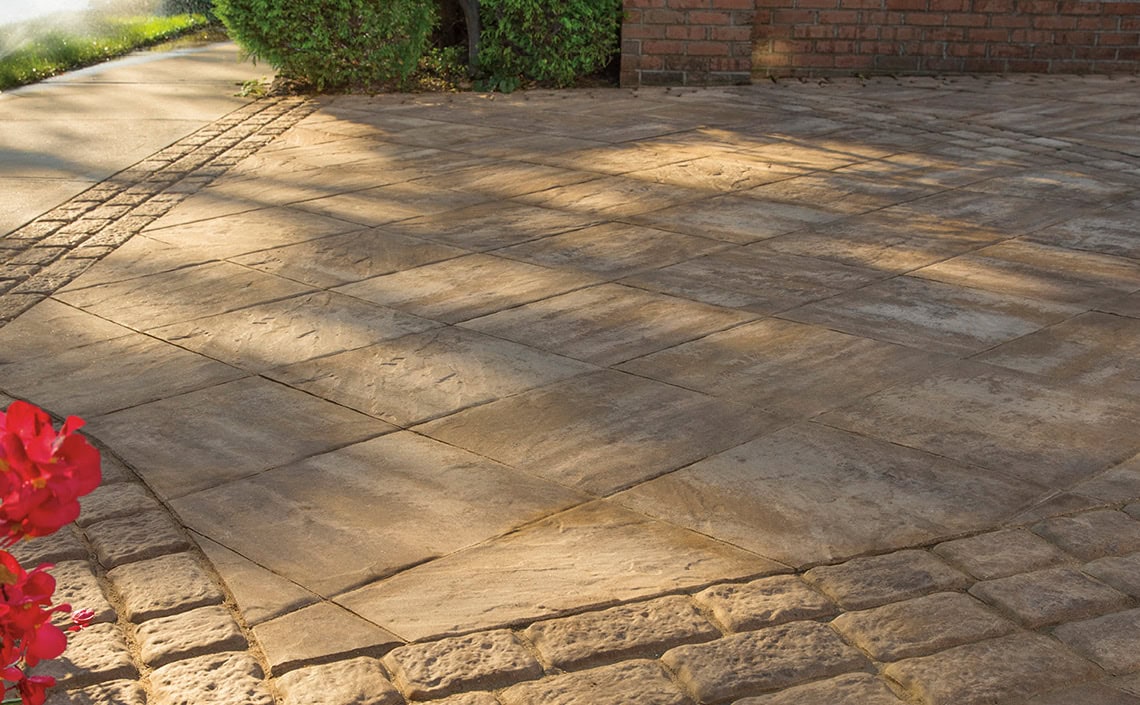
The honest answer is: it depends on how committed you are to maintenance. Travertine can be used successfully in freeze-thaw climates, but it requires proper sealing to withstand freezing conditions — and that sealing schedule needs to be kept up, not treated as optional.
For Nassau County homeowners who are willing to seal their patio on schedule and use the right de-icing products in winter, travertine is a viable choice. It’s particularly well-suited to pool decks and patios where barefoot comfort and heat dissipation are priorities. If you’re installing around a pool in Massapequa or Rockville Centre and you want something that stays cool underfoot during a hot July afternoon, travertine has a genuine functional advantage over bluestone in that specific scenario.
Where travertine becomes a harder sell is in high-traffic areas, driveways, or any application where the stone will see heavy use and isn’t getting the maintenance attention it needs. Bluestone is harder — it ranks around sixth on the Mohs scale, while travertine is softer and more susceptible to surface wear under abrasion. For a patio that gets moderate use and regular care, travertine is a reasonable choice. For a heavily trafficked surface or a homeowner who wants a lower-maintenance option, bluestone is the more forgiving material.
The key is being honest with yourself about how much maintenance you’re realistically going to do. Both materials are beautiful. One is more forgiving when life gets busy.
Limestone’s freeze-thaw performance depends heavily on its absorption rate. Low-porosity limestone — generally defined as 3% water absorption or less — performs well in freeze-thaw climates when properly sealed. Higher-porosity limestone is more vulnerable to spalling and surface damage when water saturates the stone and then freezes. If you’re considering limestone for an outdoor application in Nassau County, it’s worth asking about the specific absorption rate of the material you’re looking at — that number tells you more about real-world performance than any general claim about durability.
One characteristic worth knowing for outdoor use: limestone can lighten over time with UV exposure. This isn’t necessarily a flaw — some homeowners like the way it weathers — but it’s worth setting expectations correctly before installation. The finish you choose also matters for outdoor applications. A honed finish is common for outdoor limestone pavers and provides a smooth, matte surface that holds up better to foot traffic than a polished finish would.
For Nassau County homeowners who want the cleaner, more architectural look of limestone without the warmth of travertine or the textured character of bluestone, outdoor limestone pavers are a legitimate option. The key is choosing the right material grade for the climate and committing to the same sealing schedule that applies to any natural stone in this environment. Salt air, freeze-thaw cycles, and UV exposure are a demanding combination — the stone you choose and the care you give it both matter.
The material you choose for a blue stone paver patio in Nassau County isn’t just a style decision — it’s a performance decision. Bluestone is one of several natural stone pavers that can perform well in this climate, with the density and low porosity to handle freeze-thaw cycles and coastal salt air with proper sealing and the right de-icing products. Travertine offers real advantages for pool surrounds and sun-exposed patios, but it demands more consistent maintenance. Limestone is a strong option when you choose the right grade and treat it accordingly.
What most online guides miss is that Nassau County homeowners are dealing with two stressors at once — not just cold winters, but a coastal environment that adds pressure to every outdoor surface year-round. The right material for someone in Levittown may not be the right material for someone two blocks from the water in Long Beach or Sea Cliff.
If you’re working through this decision and want to see the materials in person before committing, Powerhouse Mason Supply’s Roslyn Heights showroom is right here in Nassau County. Our staff can walk you through the options, help you think through your specific site conditions, and connect you with experienced local contractors when you’re ready to move forward.
Article details:
Share:
Continue learning: