The materials matter — but so does where you get them. Here's what Nassau County homeowners and contractors should know before choosing a masonry supplier.
Share:

Summary:
You’ve probably spent time looking at stone veneer styles online, comparing paver colors, maybe even saving photos for your contractor. What most Nassau County homeowners don’t spend much time on is the supplier — the place where all those materials actually come from. That’s a mistake, and it tends to show up mid-project.
The supplier you choose determines whether your quantities are calculated correctly, whether materials are in stock when your crew needs them, and whether you have anyone knowledgeable to call when something doesn’t look right. Let’s walk through what you actually need to know.
The terminology around stone veneer is genuinely confusing, and it causes real problems when buyers end up with the wrong product for their application or budget. Faux stone, cultured stone, manufactured stone, natural stone — these aren’t just marketing terms. They describe meaningfully different products with different price points, installation requirements, and performance characteristics.
Understanding the landscape before you walk into a showroom or place an order saves time, money, and the kind of frustration that comes from discovering mid-project that you bought the wrong thing.
Faux rock for outside of a house — sometimes sold as faux stone veneer panels exterior or exterior veneer panels — is typically made from polyurethane or high-density foam. They’re lightweight, relatively inexpensive (materials run roughly $3–$5 per square foot), and designed for easy installation. For accent applications like a small section of foundation, a garden wall, or an interior feature wall, they can work well. They’re also the fastest to install, which keeps labor costs down.
The tradeoff is durability. Polyurethane panels aren’t rated for the same freeze-thaw performance as manufactured stone or natural stone. In Nassau County, where winter temperatures regularly drop below freezing and the freeze-thaw cycle repeats throughout the season, that matters. South Shore communities like Long Beach, Oceanside, and Massapequa also deal with salt air and coastal humidity — conditions that accelerate deterioration in lower-grade materials. Faux rock for outside of house applications in this climate needs to be selected carefully, and it’s worth having an honest conversation about where it’s appropriate and where it isn’t.
That said, modern faux stone panels exterior products have improved significantly. The better options are hand-textured, color-treated throughout (not just on the surface), and designed to hold up in varied conditions. The key is knowing which products meet the standard for your specific application and climate — and that’s where buying from someone who actually understands the material, not just the SKU, makes a real difference.
Stacked stone veneer panels exterior made from manufactured stone are a step up in durability and authenticity. These are the products most commonly used for front-of-house applications, chimney veneer, and foundation panels — and they represent the largest share of what American homeowners are actually buying right now.
Manufactured stone veneer — also called cultured stone, artificial stone for house exterior, or fake exterior stone — is made to replicate the look of natural stone. It’s cast from molds taken from actual stone, hand-painted to reflect authentic color palettes, and produced to consistent dimensions that make installation more predictable. Material costs typically run $5–$8 per square foot, which is a fraction of what natural stone commands.
Natural stone cladding exterior — bluestone, granite, marble, travertine — runs $35–$50 per square foot for materials alone. It’s heavier, harder to cut, and requires more skilled labor to install properly. The look is genuinely different from manufactured stone, and for certain homes and applications, it’s the right choice. But for most residential projects — adding stone veneer to the front of a house, updating an exterior chimney, or running stone along a foundation — manufactured stone performs comparably and costs dramatically less.
The question we hear often is whether manufactured stone looks fake. The honest answer is: the good ones don’t. Brands like Eldorado Stone, which has been hand-crafting architectural veneer since 1969, and Cultured Stone, which expanded its eco-friendly line in 2024, produce products that are genuinely difficult to distinguish from natural stone to the untrained eye. Dutch Quality Stone and Casa di Sassi — both of which we carry — are in the same category.
Natural stone veneer panels for exterior applications do have specific advantages: they’re unique (no two pieces are identical), they develop a natural patina over time, and for high-value Nassau County homes on the North Shore — in communities like Roslyn, Great Neck, or Manhasset — the premium can be justified by both aesthetics and resale positioning. But it’s a choice that should be made with accurate information, not assumptions.
Want live answers?
Connect with a Powerhouse Mason Supply expert for fast, friendly support.
Here’s what most buyers don’t realize until something goes wrong: the supplier you choose is a decision that affects your project just as much as the product you pick. Quantity calculations, inventory availability, delivery timing, sample access, and contractor support all run through the supplier. A material that’s right for your project can still cause delays, waste, and frustration if the supply chain behind it isn’t solid.
In Nassau County’s active contractor market — where crews are booking projects months in advance and schedules are tight — a late delivery or a back-ordered product doesn’t just cause inconvenience. It costs money.
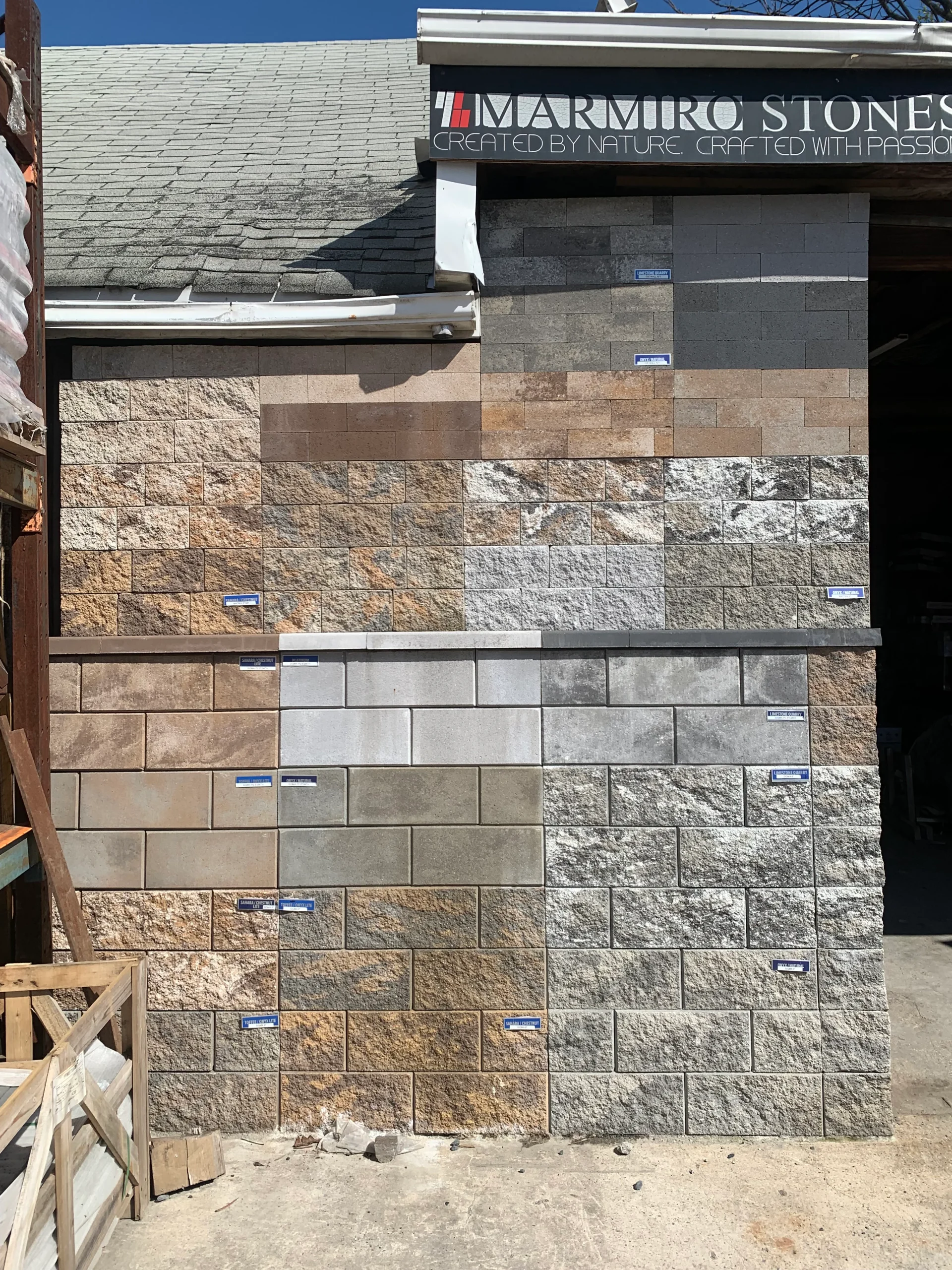
There are a few things that separate a supplier worth working with from one that simply processes transactions. The first is expertise. When you ask a question at our Roslyn Heights showroom — whether it’s about freeze-thaw ratings for a South Shore patio, mortar compatibility for a stone veneer over existing siding, or how much material you actually need for a 400-square-foot front elevation — you should get a real answer from someone who understands masonry, not a shrug and a product code.
Our team comes from generations of masons. That’s not a tagline — it means when we tell you that a specific manufactured stone product will hold up through a Nassau County winter, or that you can’t reliably install veneer over painted brick, we’re drawing on actual installation knowledge, not just catalog descriptions.
The second thing that matters is inventory. We maintain large, well-managed inventory across our three locations — Roslyn Heights, Amityville, and Huntington Station — specifically because supply delays cost contractors and homeowners real money. A survey by the Associated General Contractors of America found that 28% of U.S. contractors had paused or delayed projects during supply disruptions. That’s not a statistic you want to be on the wrong side of mid-project.
The third is flexibility. Most masonry yards sell by the pallet. We don’t require that. If you need half a pallet of Nicolock pavers for a residential walkway, we’ll break the pallet and deliver what you actually need. One of our customers recently received exactly that — half a pallet shipped to their home within three days. For Nassau County homeowners doing accent work, chimney veneer, or smaller patio projects, that kind of flexibility is the difference between a clean order and hundreds of dollars in leftover material.
Online product photos are unreliable. Color, texture, and scale all look different in person — and against your home’s existing materials, the difference can be significant. That’s why our Roslyn Heights showroom exists. You can see Cambridge Pavers, Nicolock, Eldorado Stone, Cultured Stone, Dutch Quality Stone, Casa di Sassi, and more side by side, in person, before you commit to anything.
We also offer sample boards you can take home. The deposit is fully refundable — or applied toward your order — so there’s no financial risk to testing materials against your actual exterior before making a decision. For Nassau County homeowners with mid-century colonials, cape cods, or split-levels in communities across the county, this step often changes the final material selection entirely. What looks right on a screen doesn’t always look right on a 1960s brick colonial in Garden City.
The brands we carry are authoritative in this space. Nicolock pavers come with a transferable lifetime warranty from the manufacturer — meaning the protection passes to future owners of your home. In a county where median home sale prices sit at $827,000, that’s a warranty that carries real weight. Eldorado Stone has been in the architectural veneer business since 1969. These aren’t budget brands we’re stocking to fill shelf space — they’re products we stand behind because our team knows how they perform over time in this climate.
We also connect customers with experienced local contractors when installation help is needed. If you’re sourcing materials and still looking for a qualified installer, we can point you toward professionals who know these products and work regularly in Nassau County.
The material you choose matters. But so does where it comes from, who calculated the quantities, whether it was in stock when your project started, and whether you had someone knowledgeable to call when a question came up. Those aren’t small details — they’re the difference between a project that goes smoothly and one that stalls.
Nassau County homeowners are making real investments in their properties. Exterior stone work — whether it’s a front elevation update, a paver patio, or a chimney veneer — adds measurable value in a market where homes are already appreciating. Getting the supply side right is part of getting the project right.
If you’re in the planning stages or ready to move forward, Powerhouse Mason Supply is a good place to start. Come into the Roslyn Heights showroom, bring your project details, and talk to someone who can actually help you make the right call.
—
FREQUENTLY ASKED QUESTIONS
What is the best stone for a house exterior in Nassau County?
There’s no single right answer — it depends on your budget, your home’s style, and the specific application. Manufactured stone veneer (cultured stone, Eldorado Stone, Dutch Quality Stone) is the most popular choice for residential exteriors in Nassau County because it performs well in freeze-thaw climates, looks authentic, and costs a fraction of natural stone. Natural stone — bluestone, granite, travertine — is the premium option and makes sense for high-value applications, particularly on North Shore Nassau County properties where the investment is justified by resale positioning. The best starting point is seeing both options in person at our Roslyn Heights showroom before committing.
What does natural stone for the exterior of a house cost?
Natural stone veneer for exterior walls typically runs $35–$50 per square foot for materials alone. Installation adds to that cost, and natural stone requires more skilled labor than manufactured veneer because of its irregular dimensions and weight. Manufactured stone veneer runs $5–$8 per square foot for materials — a significant difference for larger projects. Faux stone panels (polyurethane) are the most affordable option at roughly $3–$5 per square foot, though durability in Nassau County’s freeze-thaw climate should be factored into that comparison.
What does cultured stone price look like compared to natural stone?
Cultured stone — a type of manufactured stone veneer — typically costs $5–$8 per square foot for materials, compared to $35–$50 per square foot for natural stone. The gap in installation cost is also meaningful: manufactured stone installs more predictably because of its consistent dimensions, which keeps labor hours lower. For most residential applications, cultured stone delivers comparable visual results at a significantly lower total cost.
Can you put stone veneer over brick exterior?
It depends on the condition and surface of the existing brick. Veneer can be applied over uncoated brick in good condition with the right preparation. However, you simply can’t reliably install stone atop painted brick — mortar won’t adhere properly to a painted surface. If your brick has been painted, that’s a conversation to have before planning the project. We can walk you through what’s feasible based on your specific situation.
How much does it cost to put stone veneer over a brick exterior?
The total cost varies based on the scope of the project, the material selected, and the condition of the existing brick. Stone veneer installation averages around $16,000 for a full home exterior, with a range from roughly $2,500 for a small accent area up to $90,000 for a larger, premium-material project. Nassau County’s labor market also affects the final number. Getting an accurate estimate starts with knowing your square footage and material selection — both of which we can help you work through before you engage a contractor.
Where can I find natural stone veneer suppliers near me in Nassau County?
Our Roslyn Heights location at 85 Powerhouse Rd serves Nassau County directly. We carry natural stone options alongside a full range of manufactured stone veneer from brands including Eldorado Stone, Cultured Stone, Dutch Quality Stone, and Casa di Sassi. We’re open Monday through Friday 7:00 AM–5:00 PM and Saturdays 7:00 AM–1:00 PM. You can visit the showroom, see materials in person, and talk to someone who can help you choose the right product for your project and Nassau County’s climate.
Who are the best cultured stone suppliers on Long Island?
We carry Cultured Stone, Eldorado Stone, Dutch Quality Stone, and Casa di Sassi — all leading manufactured stone veneer brands — at our Roslyn Heights showroom in Nassau County. Being an authorized dealer for these brands means we meet the manufacturer’s standards for product knowledge and service, not just distribution. If you’re comparing suppliers, the right question isn’t just who carries the brand — it’s who can help you choose the right product, calculate accurate quantities, and get it delivered on time to your Nassau County home.
What is faux rock for the outside of a house, and does it hold up in winter?
Faux rock for exterior applications typically refers to polyurethane or foam-based panels designed to replicate the look of stone. They’re lightweight and affordable, but their freeze-thaw performance varies significantly by product. In Nassau County’s climate, with regular winter freezes and coastal exposure in South Shore communities, lower-grade faux panels can deteriorate faster than manufactured stone veneer. If you’re considering faux stone for an exterior application here, it’s worth discussing the specific product’s ratings before purchasing — not all exterior veneer panels are built for the same conditions.
Can stone veneer be used on exterior foundation walls?
Yes — stone veneer panels for exterior foundation applications are one of the most common uses, and they’re effective for modernizing the look of older Nassau County homes with dated or stained concrete foundations. The key considerations are proper moisture management (a water-resistive barrier is required), correct lath and scratch coat preparation, and choosing a product rated for ground-level exposure. We can walk you through the right materials and connect you with a local contractor familiar with foundation veneer installation if needed.
Is faux stone for exterior foundation walls a good idea?
It can be, depending on the product. Manufactured stone veneer is generally the more durable choice for foundation applications because it’s denser and better rated for moisture exposure than polyurethane faux panels. For Nassau County homes — especially those in areas with flooding risk or high water tables — the material and installation method both matter. We stock products specifically suited for foundation applications and can help you understand what’s appropriate for your home’s conditions.
Article details:
Share:
Continue learning: