Not all masonry supply yards are created equal. Here's what Nassau County homeowners and contractors should know before they start shopping for materials.
Share:
Summary:
You type “masonry supply near my location” into Google, and a dozen results come back. Some are big-box stores. Some are manufacturer websites. A few are actual local yards. And now you have to figure out which one is actually worth your time.
If you’re somewhere in Nassau County, NY — whether you’re in Manhasset, Hicksville, Oyster Bay, or anywhere in between — the options aren’t all equal. The right supplier makes a project go smoothly. The wrong one costs you time, materials, and sometimes the whole job. Here’s what you actually need to know before you load up and go.
A masonry supply yard is a specialty distributor that carries the materials used to build and finish hardscapes — driveways, patios, walkways, retaining walls, outdoor kitchens, stone veneers, and more. Think concrete pavers, natural stone, porcelain tile, wall systems, coping, aggregates, sand, and construction block. It’s not a hardware store, and it’s not a landscaping center. It’s a focused operation built around the materials that go into the ground and onto the walls of outdoor projects.
The difference between a good yard and a mediocre one usually comes down to two things: selection and staff. A wide product range matters because your project has specific requirements — color, texture, size, load-bearing capacity, and climate performance all factor in. And staff knowledge matters because picking the wrong material is an expensive mistake, especially when you’re dealing with the quantities a typical Nassau County, NY driveway or patio requires.
This comes up constantly, and it’s worth being direct about. Big-box stores carry some basic masonry products — standard concrete pavers, bags of mortar, a limited range of block. For small repairs or simple DIY jobs, that might be enough. But for anything beyond the basics, the limitations show up fast.
The brand selection at a home improvement chain is narrow. You’re not going to find Cambridge Pavers, Nicolock, Eldorado Stone, Dutch Quality Stone, or Casa di Sassi at a big-box store. These are premium brands with engineered performance characteristics — freeze-thaw ratings, surface protection technology, lifetime warranties — that basic commodity pavers don’t offer. When a Nassau County homeowner spends the money on a new driveway or a full backyard patio, they’re usually not looking for the cheapest paver on the shelf. They want something that’s going to hold up through twenty Long Island winters and still look good doing it.
The other gap is expertise. At a specialty masonry yard, the people behind the counter have usually worked with these materials for years — in some cases, they come from families of masons. They can look at your project, estimate your quantities, flag potential issues with your material choice, and point you toward products that actually suit your application. That kind of guidance doesn’t exist at a big-box store, and it’s not a small thing. Miscalculating quantities, choosing a paver that isn’t rated for your climate, or picking a stone veneer that doesn’t bond properly to your substrate are all mistakes that cost real money to fix.
At Powerhouse Mason Supply, our family comes from generations of masons. That’s not a tagline — it means the people you’re talking to have hands-on knowledge of how these materials actually perform, not just what the spec sheet says. Customers have specifically called out staff members by name in reviews for the quality of advice they received, and that kind of consistent, personalized guidance is exactly what separates a specialty yard from a retail chain.
Most big-box stores won’t break a pallet. If your project needs less than a full pallet of pavers, you’re either buying more than you need or you’re out of luck. We can work with you on that — flexibility that matters when you’re managing a project budget.
The range of masonry building supplies at a quality yard is broader than most people expect when they first walk in. Concrete pavers are usually what people come in looking for, but they’re just the starting point.
Natural stone — bluestone, granite, limestone, travertine — offers a different aesthetic and a different performance profile than manufactured concrete. Porcelain pavers have become increasingly popular in coastal Nassau County communities like Long Beach, Oceanside, and Freeport, where salt air accelerates weathering on materials that aren’t sealed or inherently resistant. Porcelain handles that environment well, which is why it’s worth knowing about if you’re close to the South Shore.
Stone veneers are a separate category entirely — these are the materials that go on the face of a wall, a fireplace surround, a retaining wall cap, or an exterior facade. Brands like Eldorado Stone, Dutch Quality Stone, Cultured Stone, and Casa di Sassi each have distinct styles and installation profiles. Choosing the right one depends on the substrate, the look you’re after, and how much weather exposure the surface will see.
Then there are the structural materials: concrete block, retaining wall systems, aggregates, sand, and fill. These don’t get photographed for Instagram, but they’re what holds everything else in place. A yard that only carries the decorative stuff and skips the structural materials forces you to make a second stop — and that’s a problem when you’re trying to keep a project on schedule.
We carry all of it under one roof across our three Long Island locations, including our Roslyn Heights showroom in Nassau County, NY. The goal is that you can come in, get what you need for the full project, and leave without having to piece together your materials from three different suppliers.
Want live answers?
Connect with a Powerhouse Mason Supply expert for fast, friendly support.
Proximity matters, but it’s not the whole story. The nearest masonry supply yard to your location in Nassau County, NY might be a great fit — or it might be a yard with limited inventory, no showroom, and staff who can’t tell you whether a particular paver will survive Long Island’s freeze-thaw cycles. Distance is easy to measure. Quality takes a little more digging.
What you’re actually looking for is a yard that’s close enough to be convenient, deep enough in inventory to have what you need, and staffed by people who can give you a straight answer when you ask a real question. In Nassau County, that combination is available — but it’s worth knowing what to look for before you commit.
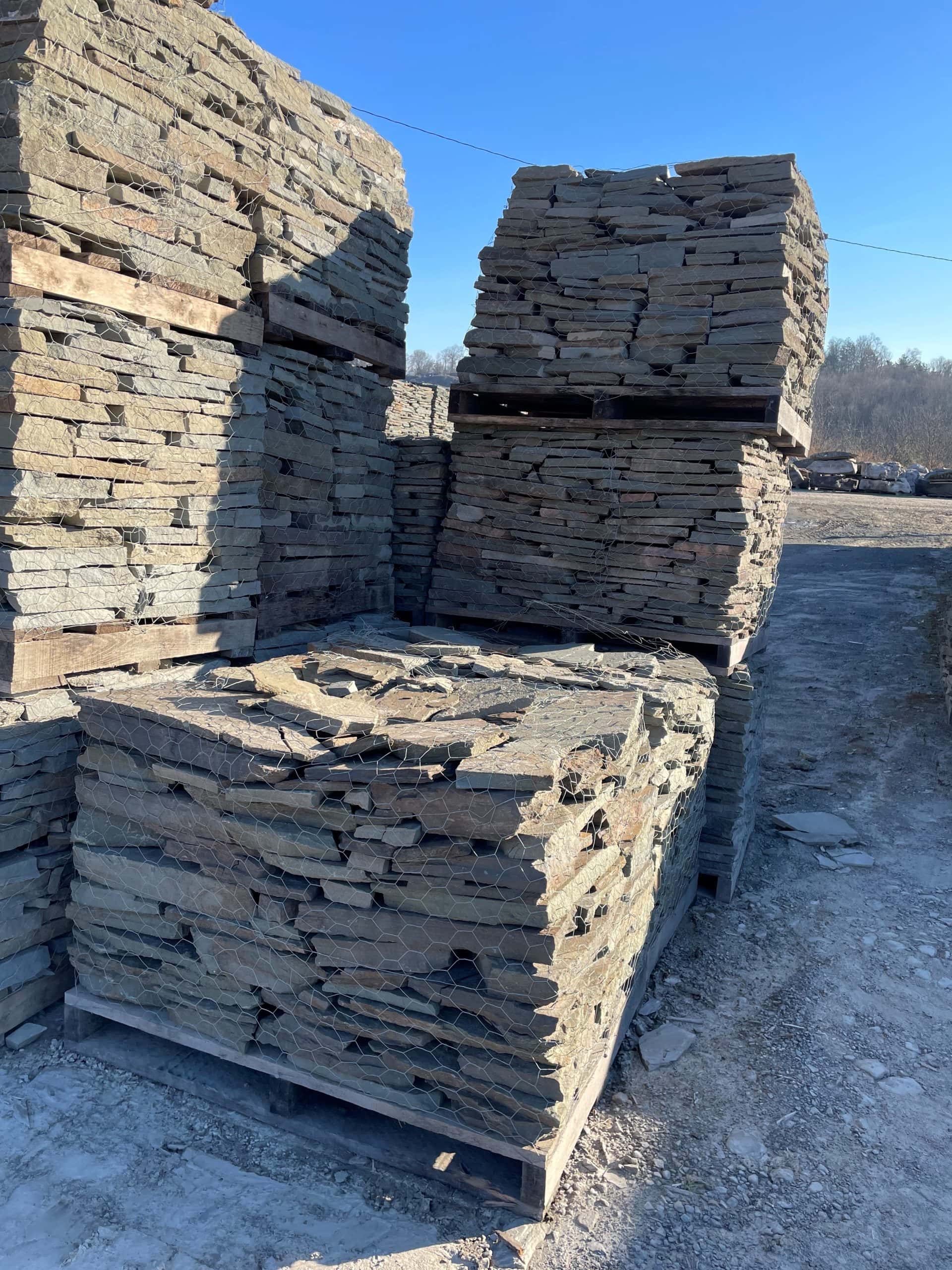
Long Island’s winters are not gentle. Nassau County experiences significant freeze-thaw cycling — temperatures regularly cross the freezing threshold multiple times throughout the season, which creates a repeated expansion-and-contraction stress on any material that holds moisture. Inferior pavers crack under this kind of cycling, sometimes within just a few seasons. It’s the kind of thing that looks fine in the first year and becomes a visible problem by year three or four.
This is why ASTM ratings matter. The American Society of Testing Materials sets standards for concrete paver strength, water absorption, and freeze-thaw resistance. Products that meet or exceed ASTM C936 — the standard for interlocking concrete paving units — are the baseline for quality in this climate. Brands like Nicolock, which also exceeds Interlocking Concrete Pavement Institute (ICPI) standards, and Cambridge Pavers, which uses AmorTec technology to drive color throughout the entire paver rather than just the surface, are engineered specifically to handle conditions like ours. When surface wear happens — and it will, over time — you’re not exposing a gray concrete core underneath.
For Nassau County’s South Shore communities, there’s an additional factor: salt air. Oceanside, Wantagh, Massapequa, Long Beach — these are all within a few miles of the Atlantic, and that proximity means outdoor materials face accelerated weathering from salt exposure. Sealed natural stone and porcelain pavers hold up particularly well in these environments. It’s something most people don’t think to ask about, but a knowledgeable supplier will bring it up without being prompted.
The North Shore is a different story. Communities like Roslyn, Manhasset, Port Washington, and Great Neck tend to prioritize aesthetics alongside durability — high-end residential projects where the look of the material matters as much as its performance. Natural stone, premium concrete pavers, and stone veneers are all in strong demand here, and the range of options available at a full-service yard is what makes those projects possible.
Most people assume the process is straightforward: you find a yard, pick your materials, load up, and go. And sometimes it is that simple. But for larger projects — a full driveway replacement, a backyard patio, a retaining wall — there are a few steps in between that can make a significant difference in how the project goes.
The first is the consultation. We’ll sit down with you, look at what you’re trying to do, and help you work through the material selection. This isn’t just about aesthetics — it’s about quantities, compatibility, and application. How many square feet are you covering? What’s the base situation? Are you dealing with a slope that needs a wall system, or a flat surface where drainage is the main concern? These questions affect what you buy and how much of it you need.
The second is delivery. Heavy materials — pavers, stone, aggregates, block — aren’t something most homeowners can transport in a pickup truck at the scale a real project requires. We offer flexible delivery for all construction materials and maintain a large inventory specifically to avoid the mid-project delays that happen when a yard runs low on what you need.
The third — and this is something most supply yards don’t offer — is contractor connections. A lot of Nassau County homeowners come to us knowing what they want but not knowing who’s going to install it. We have an established network of experienced local Long Island contractors, and we can connect you with someone who knows our materials and knows this market. It’s not a formal referral service with a fee attached — it’s just part of how we operate, because we’d rather see a project finished right than leave a customer to figure out the installation side on their own.
If you’re working with a contractor already, they may have a preferred supplier relationship that brings them here directly. Either way, the path from material selection to finished project is one we’ve helped a lot of Nassau County homeowners navigate.
Look for a yard with real inventory depth, staff who know the materials from the ground up, a showroom where you can see things in person, and a track record in this specific market. Proximity is a factor, but it shouldn’t be the only one.
Nassau County has enough going on — climate-wise, aesthetically, and in terms of the sheer variety of projects homeowners tackle here — that a generic supplier with limited selection and limited expertise is going to leave gaps. The right yard closes those gaps before your project even starts.
We’ve been doing this on Long Island for over 20 years. Come into our Roslyn Heights showroom in Nassau County, bring your project details, and we’ll take it from there.
Article details:
Share:
Continue learning: