Paver patio prices on Long Island are nothing like what you see online. Here's what Nassau County homeowners actually pay in 2026 — and why the gap is so large.
Share:

Summary:
You’ve probably seen numbers like $8 to $25 per square foot floating around online. Then you called a Long Island contractor and heard something closer to $30 to $45. That gap isn’t a mistake — it’s one of the most common points of confusion for Nassau County homeowners planning a paver patio, and it catches a lot of people off guard mid-project.
The truth is, what you pay depends on where you live, what material you choose, and how the job is put together underneath. We’ve spent 25 years watching Long Island projects come together from our supply yard perspective, so you get a straight answer on what things actually cost and why.
Here’s the number that matters most for Nassau County: professionally installed paver patios on Long Island typically run $20 to $45 per square foot, depending on the material and the complexity of the job.
Standard concrete pavers — your Cambridge or Nicolock lines — generally land in the $20 to $25 per square foot range when installed. Step up to premium concrete options with textured finishes or larger formats, and you’re looking at $25 to $30. Natural bluestone, which has been the default patio material in Nassau County neighborhoods for decades, runs $25 to $35 installed. Porcelain pavers — increasingly popular, especially on the South Shore where salt air is a factor — tend to fall between $30 and $45 per square foot installed.
Those are installed figures. Materials alone are a fraction of that. Standard concrete pavers as a material run $2 to $6 per square foot. That’s why the numbers you find online look so different from what contractors quote — one number is the cost of the paver itself, the other is the cost of the entire finished project. The paver is typically only about 20% of the total budget. The rest is excavation, base preparation, bedding sand, edge restraints, and labor.
Nassau County isn’t a cheap market for any kind of construction work, and paver installation is no exception. Labor rates here are meaningfully higher than the national average. Delivery costs add up when you’re moving heavy material across dense suburban streets.
The ground itself — Long Island’s soil, its freeze-thaw cycles, its coastal conditions in communities like Long Beach, Oceanside, and Merrick — demands more careful base preparation than you’d need in a milder climate. Long Island winters don’t just get cold — they cycle above and below freezing repeatedly throughout the season. Poured concrete doesn’t handle that well. Water gets into hairline cracks, freezes, expands, and widens the crack. That’s why so many Nassau County homeowners are replacing original 1960s concrete patios right now — the material was never well-suited to this climate in the first place.
Interlocking pavers flex with ground movement. If one shifts or cracks, you replace that paver, not the entire surface. Cambridge and Nicolock — the two brands we stock at our Roslyn Heights showroom — are both Northeast manufacturers. Their products are engineered and tested specifically for the freeze-thaw conditions Long Island sees every winter. Both brands also carry lifetime manufacturer warranties, which is a genuine long-term value consideration when you’re looking at a project that should last 25 to 50 years.
The density of Nassau County lots also plays a role in pricing. Smaller yards, tighter access, and less room to maneuver equipment can add time and cost to a job that might be straightforward on a larger Suffolk County property. A 200 to 400 square foot patio — common in Nassau — is a different logistical challenge than an open suburban lot with easy equipment access.
A 400 square foot patio is a reasonable benchmark for a mid-sized Nassau County project — enough space for outdoor furniture, a grill, and some room to move. At the standard concrete paver range of $20 to $25 per square foot installed, that’s roughly $8,000 to $10,000 for the complete job. Step up to natural bluestone and the same footprint runs $10,000 to $14,000. Porcelain at the higher end of the range could push past that.
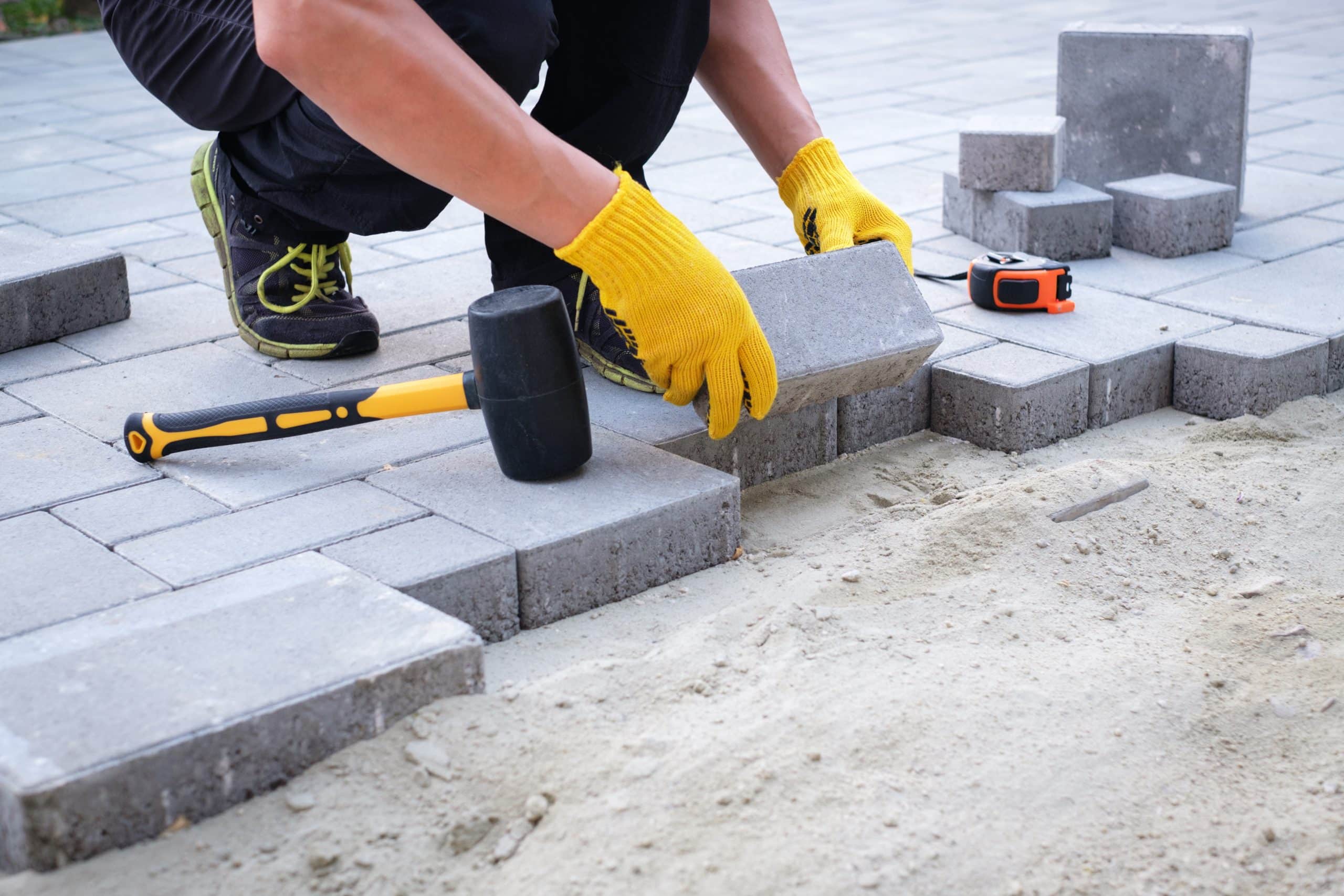
These aren’t figures we invented. They’re consistent with what Long Island contractors are quoting in 2026, and they’re grounded in real material and labor costs in this market. If a quote comes in dramatically lower, it’s worth asking what’s being left out — specifically, the base preparation. A proper installation requires excavating to adequate depth, compacting a crushed stone base, adding a bedding sand layer, and sloping the surface away from your home for drainage. Skipping or shortcutting any of those steps is how a patio looks fine for two years and then starts to shift, settle, and develop drainage problems.
When you’re comparing proposals from different contractors, ask specifically what’s included in the base — depth of excavation, type of gravel, whether polymeric sand is being used in the joints. Polymeric sand matters because regular sand lets weeds grow through and ants tunnel under. It’s a small detail that makes a real difference over time.
If you’re working with a tighter budget, the size and pattern of the patio have more impact on cost than most people realize. A simple running bond pattern in a standard-size paver is significantly less labor-intensive than a herringbone or custom design — complex patterns can add 15 to 25 percent to labor costs alone. Keeping the shape rectangular and the pattern straightforward is the most effective way to manage cost without compromising on material quality.
Want live answers?
Connect with a Powerhouse Mason Supply expert for fast, friendly support.
Most Long Island cost guides lead with premium options — large-format porcelain, custom bluestone, tumbled travertine — and treat the budget tier as an afterthought. That’s backwards for a lot of Nassau County homeowners who want a quality patio without spending $40 a square foot.
The honest answer is that entry-level concrete pavers from Cambridge or Nicolock represent genuinely excellent value. These aren’t inferior products. They’re manufactured to ASTM standards for compressive strength and freeze-thaw resistance, they carry lifetime warranties, and they look good. The difference between a base-line Cambridge paver and a premium one is mostly aesthetic — surface texture, finish options, color range — not durability. If your goal is a clean, lasting patio that holds up through Long Island winters, a standard concrete paver gets you there.
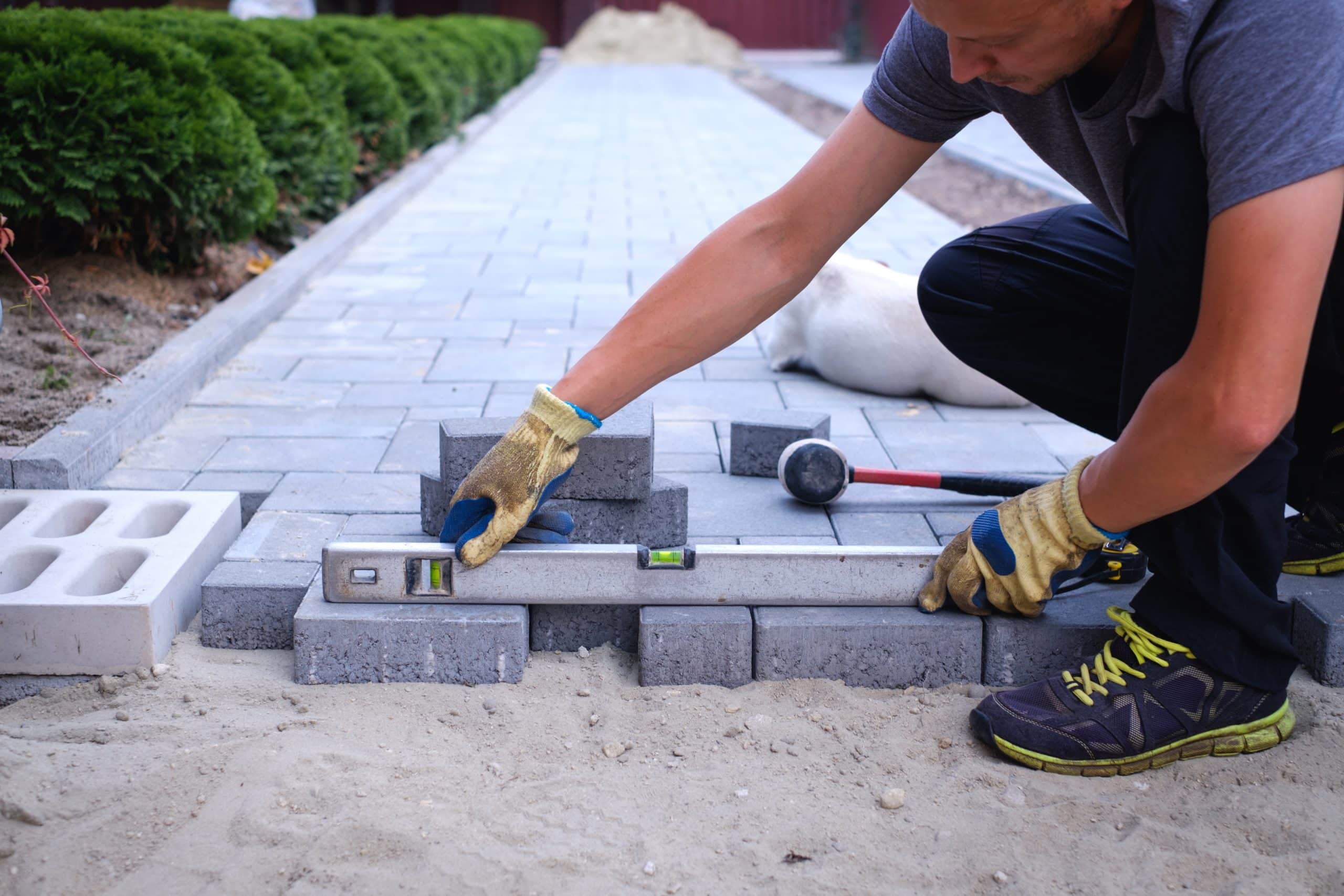
Standard concrete pavers — think Nicolock’s base lines or Cambridge’s Classic series — are the most accessible entry point into a quality paver patio on Long Island. At $2 to $6 per square foot for materials, they’re a fraction of the cost of natural stone or porcelain, and they install cleanly with a predictable result.
What makes them genuinely worth considering isn’t just the price — it’s the consistency. Concrete pavers are uniform in thickness and dimension, which makes installation faster and base preparation more straightforward. Natural stone has variation in thickness that requires more skilled labor to compensate for, which adds cost. If you’re working with a contractor who’s quoting a tight budget, standard concrete pavers give them the best shot at delivering a clean job without cutting corners elsewhere to make the numbers work.
The practical question for most Nassau County homeowners isn’t “can I afford pavers” — it’s “which pavers make sense for what I’m trying to do.” A simple rectangular patio in a standard concrete paver, installed with a proper base and polymeric sand in the joints, will outperform poured concrete in this climate and look good doing it. You don’t need to spend $45 a square foot to get a patio that lasts.
At our Roslyn Heights showroom — the only Powerhouse Mason Supply location in Nassau County — you can see the full range side by side. Colors and textures look different in person than they do on a screen, and the difference between a $3 per square foot paver and a $12 per square foot paver becomes immediately clear when you’re standing in front of both. We also carry flexible quantities, so if your project is smaller and you don’t need a full pallet, that’s not a problem. Most supply yards won’t break a pallet — we do.
We can also connect you with experienced local Long Island contractors who know how to work with these materials in Nassau County conditions. The referral network exists because a good paver installation depends as much on the installer as it does on the material — and we’ve seen enough Long Island projects to know which contractors do the job right.
**Is a paver patio worth it compared to poured concrete on Long Island?**
For most Nassau County homeowners, yes — and the climate is the main reason. Long Island’s freeze-thaw winters are genuinely hard on poured concrete. Once a crack forms, water gets in, freezes, and widens it. Pavers flex, and individual units can be replaced if something shifts. The upfront cost is higher, but the long-term maintenance picture is typically better, especially in a market where home values average close to $786,000 and a crumbling concrete patio is a real liability at resale.
**Do I need a permit for a paver patio in Nassau County?**
It depends on your specific municipality. Nassau County is made up of dozens of distinct communities — Garden City, Oyster Bay, Hempstead, and Great Neck — and permit requirements vary. Some municipalities require permits for patio installations that affect drainage or exceed certain square footages. Before breaking ground, it’s worth a quick call to your local building department. Your contractor should know the local rules, but it’s your property and ultimately your responsibility to confirm.
**What’s the difference between Cambridge and Nicolock pavers?**
Both are Northeast manufacturers, both carry lifetime warranties, and both are well-suited to Long Island’s climate. Cambridge offers a lifetime limited manufacturer warranty. Nicolock’s warranty is transferable — once — to the next homeowner, which can be a real selling point if you’re thinking about resale value. The practical differences come down to specific product lines, color options, and surface finishes. The best way to compare them is to see both in person, which you can do at our Roslyn Heights showroom.
**Why are contractor quotes so much higher than what I see online?**
Because online prices are almost always materials only. The paver itself is roughly 20% of the total project cost. The rest — excavation, crushed stone base, bedding sand, edge restraints, polymeric sand, and labor — makes up the other 80%. A quote of $30 per square foot installed isn’t inflated; it reflects what it actually costs to do the job properly in the Nassau County market.
The most useful thing you can take from this guide is the distinction between materials cost and installed cost. If you go into contractor conversations knowing that $20 to $45 per square foot is the realistic Long Island range — and that the paver itself is only a fraction of that — you’ll be in a much stronger position to evaluate quotes, ask the right questions, and avoid being surprised.
Material choice matters, but it doesn’t have to mean overspending. Standard concrete pavers from Cambridge or Nicolock deliver genuine durability in Long Island’s climate, carry lifetime warranties, and cost a fraction of what premium stone runs per square foot. The base preparation and the installer matter just as much as the paver you pick.
If you’re in Nassau County and ready to start comparing options, visit Powerhouse Mason Supply’s Roslyn Heights showroom — the only location we have in Nassau County. Bring your measurements, and we’ll help you figure out what makes sense for your project and your budget. We’ve been working with these materials on Long Island for over 25 years, and we’re here to help you get it right.
Article details:
Share:
Continue learning: