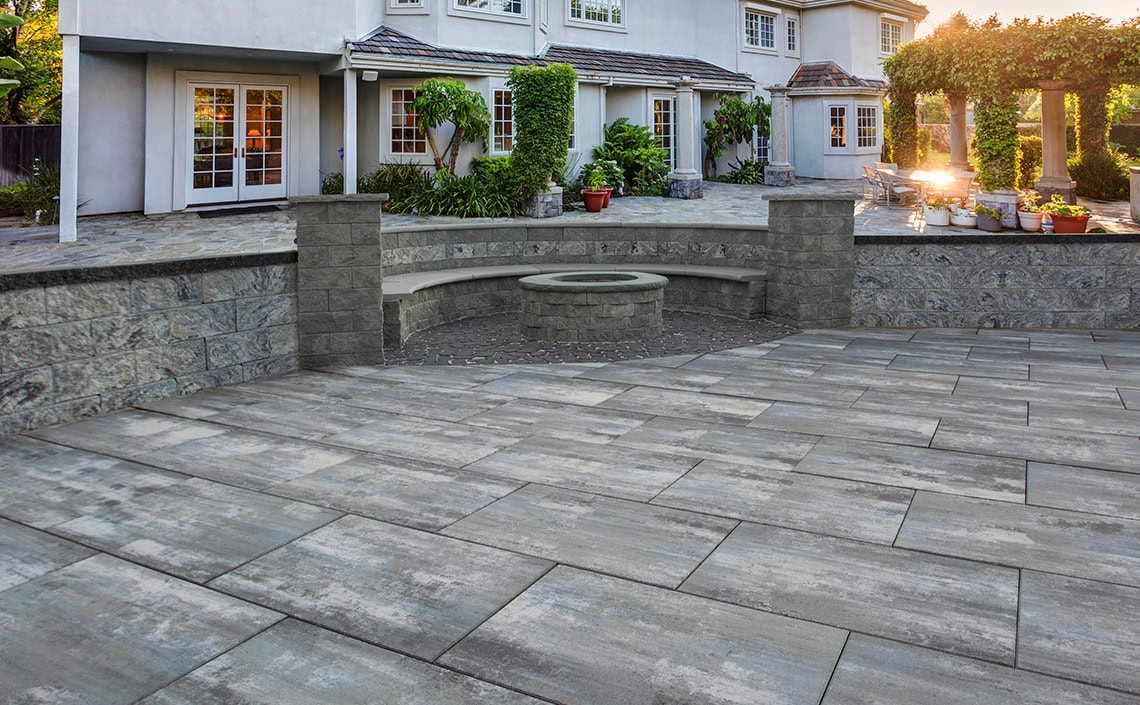
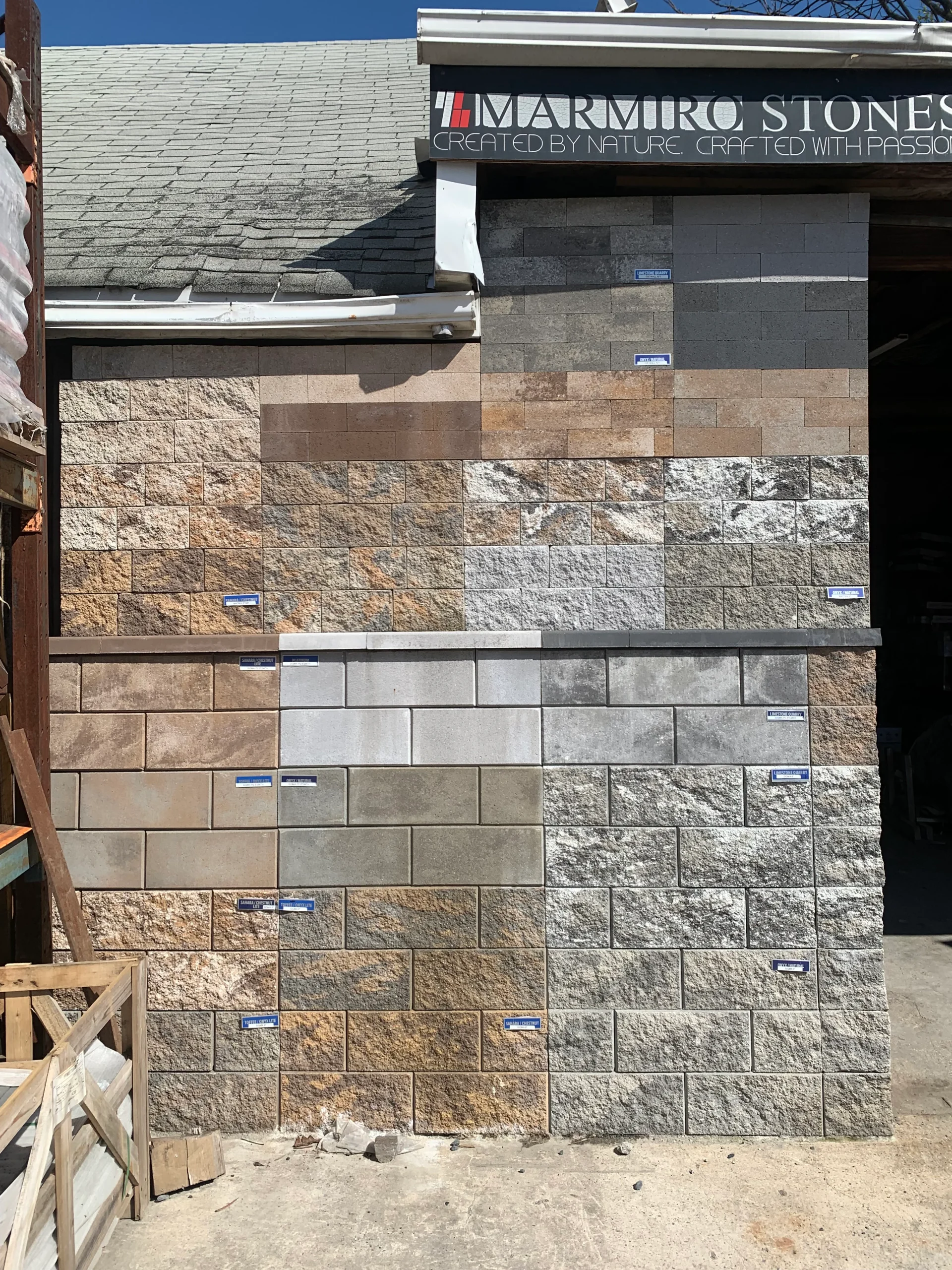
Choosing between pavers and poured concrete? Here's what Nassau County homeowners actually need to know before making a decision they'll live with for decades.
Share:
Summary:
If you’re staring at a cracked driveway or a patio that’s seen better days, you’ve probably already Googled this comparison. And you’ve probably found a lot of pages that tell you pavers look beautiful and boost curb appeal — without actually helping you decide.
Here’s what most of those pages skip: Nassau County’s climate is unusually hard on poured concrete, and the reasons why matter more than any design argument. We’ve been supplying masonry materials to Long Island homeowners and contractors for over 25 years, and we’ve watched this play out enough times to give you a straight answer. Let’s start with what’s actually happening to your concrete — and why the choice you make now will follow you for decades.
Poured concrete is less expensive upfront. In Nassau County, a poured concrete driveway typically runs $8 to $12 per square foot installed. Concrete pavers, by comparison, generally land between $16 and $19 per square foot once you factor in base preparation, labor, and materials. That gap is real, and it’s fair to take it seriously.
But the upfront number is only part of the story. Poured concrete needs to be sealed every two to three years at roughly $1.50 to $3 per square foot just to slow down moisture infiltration. It still cracks. When it does, your options are a visible patch or a full re-pour. Pavers, on the other hand, can last 50 or more years with minimal maintenance — and if a section ever settles, we can connect you with a contractor who can lift those specific units, re-compact the base, and relay them without touching the rest of the surface.
Over a 25- to 30-year span, the total cost of ownership often closes the gap considerably. For homeowners in Levittown, Wantagh, or Farmingdale who are replacing concrete that was poured in the 1960s or 70s, the question worth asking isn’t “which is cheaper to install?” It’s “do I want to have this conversation again in 15 years?”
Here’s something most comparison pages don’t tell you: Nassau County’s coastal location doesn’t protect your concrete from freeze-thaw damage — it may actually make things worse.
Deep, sustained cold is hard on concrete, but it’s the oscillation around 32°F that does the real damage. When temperatures cross the freezing point repeatedly throughout a single winter — which happens regularly on Long Island because the ocean moderates the extremes — water trapped inside a concrete slab freezes, expands, thaws, and refreezes. Each cycle widens whatever cracks already exist. The slab doesn’t fail all at once; it just gets a little worse every season until patching stops being a reasonable option.
This is why so many Nassau County homeowners with homes built in the postwar era are dealing with failing concrete right now. The housing stock in communities like Levittown, Massapequa, and Wantagh was largely built in the 1950s and 60s. Those original concrete driveways and patios are now 50 to 70 years old, and they’ve absorbed decades of freeze-thaw stress on top of road salt runoff from nearby streets. The surface may look patchable, but the underlying slab has often been compromised for years.
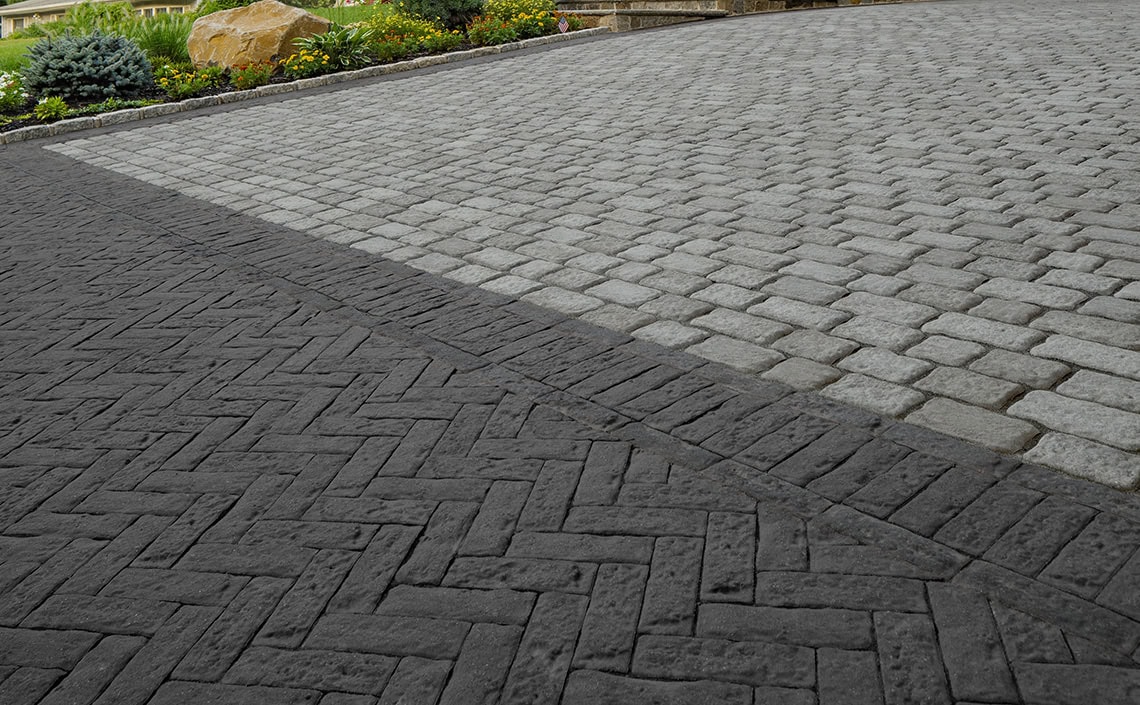
Concrete pavers handle this environment differently. Each unit is manufactured to meet ICPI standards requiring a minimum compressive strength of 8,500 psi — roughly three times stronger than poured concrete — and must survive at least 50 freeze-thaw cycles without significant material loss. Quality pavers from brands like Nicolock and Cambridge are specifically engineered for cold-climate, high-salt environments. They’re not immune to the elements, but they’re built for exactly what Long Island winters deliver.
There’s also a structural advantage worth understanding. Because pavers are individual units with jointed edges rather than a single rigid slab, the surface can flex slightly with ground movement and temperature changes. When stress builds, the system accommodates it. When a poured slab faces the same stress, it has nowhere to go — so it cracks.
Maintenance is where the two materials diverge most sharply — and where the long-term cost comparison really starts to shift.
When poured concrete cracks, your realistic options are limited. Small cracks can be filled, but the repair is almost always visible, and it doesn’t address whatever caused the crack in the first place. If the base has shifted or the slab has heaved, a surface patch won’t hold. Eventually, you’re looking at cutting out a section or re-pouring the entire slab. Neither option is cheap, and neither one is invisible.
With pavers, a problem area is a localized repair. If a section settles — usually because the base wasn’t compacted properly during installation — a contractor can lift those specific units, fix what’s underneath, and relay them. The surrounding surface stays intact. The repaired section blends back in. You’re not tearing out a driveway; you’re addressing a specific spot.
This is also why installer quality matters so much with pavers. The paver itself is durable — the engineering standards back that up. But a paver installed on a poorly compacted base will shift, and no amount of product quality compensates for a bad foundation. When you’re choosing a contractor, ask specifically about their base preparation process: how deep they go, what materials they use, and how they handle drainage. A properly installed paver surface — with a well-compacted aggregate base, a sand bedding layer, and polymeric sand in the joints — should give you decades of low-maintenance use.
One more practical note: pavers are ready to use immediately after installation. There’s no cure time. If your project window is tight — which it often is in Nassau County, where the usable outdoor season runs roughly from spring through mid-fall — that matters.
Want live answers?
Connect with a Powerhouse Mason Supply expert for fast, friendly support.
This is one of the most common questions we hear, and the honest answer is: sometimes, yes — but it depends on the condition of the existing slab.
If your concrete patio is structurally sound — no major heaving, no significant cracking, draining properly — it can serve as a base for pavers in certain applications. This approach saves the cost and labor of demolition, which is a real consideration. If the slab is already heaving, cracking badly, or has drainage problems, laying pavers on top won’t fix those issues. It will just cover them temporarily.
The right answer for your specific situation depends on what’s actually going on with your slab, which is worth evaluating before you commit to either approach.

When the existing slab is in good shape and the overlay approach makes sense, material choice matters more than it does in a standard installation.
Porcelain pavers are one of the most popular choices for this application, and for good reason. They have a thinner profile than standard concrete pavers, which helps manage the height increase that comes with any overlay installation. They’re also essentially non-porous — water absorption is near zero — which makes them particularly well-suited to Nassau County’s combination of coastal humidity, freeze-thaw cycles, and salt exposure. Porcelain pavers don’t require sealing, resist staining, and hold up well in conditions that would stress other materials over time.
Natural stone — bluestone, granite, travertine — is another option for overlay applications, depending on the project. Each material has its own characteristics in terms of texture, appearance, and performance in cold weather. Travertine is a popular choice for patios and pool surrounds, but its natural porosity means it behaves differently than porcelain in freeze-thaw conditions. Bluestone is a long-standing staple on Long Island and holds up well when properly installed.
Standard concrete pavers can also be used in overlay applications under the right conditions, though manufacturer guidelines vary. Some manufacturers have specific requirements about what voids their warranty in this type of installation, so it’s worth confirming current specs before you proceed. This is exactly the kind of question our team at the showroom can help you work through — not with a generic answer, but with the specifics of your project in mind.
The key takeaway is that “pavers over concrete” isn’t a shortcut or a compromise. Done correctly, on a sound slab, with the right material for the application, it’s a legitimate approach that can save demolition costs without sacrificing the durability you’re after.
Most of the paver installations that disappoint homeowners don’t fail because of the product. They fail because of what happened before the first paver was laid — or because the homeowner didn’t have enough information going into the project to ask the right questions.
A few things worth knowing before you commit to anything:
The brand decision matters less than the base. Nicolock and Cambridge are both excellent, well-established brands with long track records on Long Island. Nicolock manufactures on Long Island and has been doing so for over 50 years. Cambridge has a strong product line with its own surface technology. The honest answer is that either brand, installed correctly by a qualified contractor, will outlast any poured concrete alternative. Spending a lot of time agonizing over brand while skipping questions about base preparation is the wrong order of priorities.
Ask your contractor specifically about base depth and compaction. For a driveway, a proper base typically involves 10 to 12 inches of compacted aggregate. For a patio or walkway, requirements vary. The base is what keeps pavers level and stable over time — it’s not glamorous, but it’s where the job is won or lost.
Polymeric sand matters. The jointing sand used between pavers affects long-term performance more than most homeowners realize. Standard sand erodes, allows weed growth, and invites ant activity. Polymeric sand hardens when wet, resists erosion, and significantly reduces maintenance. It’s a small cost difference that pays off over the life of the installation.
Verify contractor licensing. Nassau County requires home improvement contractor licensing, and it’s worth taking five minutes to confirm any contractor you’re considering is properly licensed before signing anything.
We’ve spent 25 years building relationships with experienced local installers across Long Island. If you’re not sure where to start, we can connect you with contractors who know how to do this work correctly — and who source their materials from us, which means they’re working with products they know and trust.
Poured concrete is cheaper to install. Pavers are more expensive upfront and built to last significantly longer in the conditions Nassau County actually delivers. That’s the honest summary, and the right choice depends on your timeline, your budget, and how long you plan to stay in your home.
What we’d push back on is the assumption that concrete is the practical, sensible default. For a home in Levittown, Wantagh, or anywhere else in Nassau County where the original concrete has already failed once, re-pouring is choosing to solve the same problem again in another 15 to 20 years. That’s not practical — it’s just familiar.
If you’re ready to think through the specifics — material options, what’s right for your slab situation, which brands we have in stock — come visit us at our Roslyn Heights or Amityville showroom, or give us a call. Powerhouse Mason Supply has been helping Long Island homeowners and contractors make this decision for over 25 years, and we’re happy to give you a straight answer.
Article details:
Share:
Continue learning: