Every Nassau County, NY winter takes a toll on your driveway. Here's how permeable pavers compare to the repair bills you've been quietly absorbing for years.
Share:

Summary:
Your driveway probably doesn’t look terrible right now. Maybe a few cracks, some pooling after rain, a section that heaves a little every spring. You’ve patched it. You’ve sealed it. And every March, there’s something new to deal with.
That cycle isn’t a maintenance issue — it’s a design problem. Most Nassau County driveways were built with materials that were never meant to handle 30 to 40 freeze-thaw cycles a winter. If you’re wondering whether a permeable driveway is worth the cost before another winter rolls through, that’s exactly what we’re going to walk through here.
A permeable driveway is a surface designed to let water move through it rather than pool on top of it. Instead of shedding water onto your lawn, into the street, or under your slab where it freezes and expands, a permeable system directs water down through the joints and into a reservoir of open-graded stone beneath the surface. From there, it slowly infiltrates the soil or drains away safely.
The key difference isn’t the surface you see — it’s what’s underneath. A permeable system requires a deeper excavation, often 12 to 24 inches, and a specialized base of crushed angular stone that holds water temporarily and releases it gradually. That base is where the system either works or fails, which is why the installer’s experience matters as much as the material itself.
Here’s a question worth sitting with: how much have you spent on your driveway in the last ten years? Not the original install — just the patches, the crack fills, the sealing, the pothole repairs. For a lot of Nassau County homeowners, that number is higher than they realize.
A single concrete driveway repair runs $500 to $2,000 depending on the scope. Pothole repairs from freeze-thaw damage average $150 to $300 each. And if you’ve had to reseal every few years, that’s another recurring cost on top of it. Meanwhile, if a permeable paver gets damaged, you pull that unit and replace it — typically $100 to $300 for the repair — without touching the rest of the surface.
The paver replacement cost advantage is real, and it compounds over time. Concrete and asphalt fail as a system. When one section cracks, water gets underneath, freezes, and the damage spreads. Pavers fail individually. You address the problem at the source without opening up a bigger repair than you bargained for.
What makes this especially relevant for Nassau County is the age of the housing stock. The average single-family home here is about 73 years old. A lot of those driveways are on their second or third surface, each one patched and repatched through decades of Long Island winters. If your driveway is already showing stress — pooling water, heaving edges, surface cracking — it’s not going to get better on its own.
Each freeze-thaw cycle is essentially a hydraulic jack working on whatever weakness is already there. Water expands roughly 9% when it freezes. Over 30 to 40 cycles a winter, that force adds up fast.
The math isn’t complicated. If you spend $1,000 to $2,000 every few years keeping a compromised surface functional, and a permeable paver upgrade runs $8 to $12 per square foot installed for concrete options, a standard two-car driveway often lands in the $5,000 to $12,000 range total. That’s not a small number. But it’s also not a number that looks as large when you account for what you’ve already spent — and what you’ll keep spending if nothing changes.
Permeable driveways aren’t one-size-fits-all. Concrete pavers are among the most common choice — practical, durable, and available in a wide range of styles. But for homes in Roslyn, NY, Manhasset, NY, Great Neck, NY, or other parts of Nassau County where the property and the neighborhood demand something more, natural paving materials are worth a serious look.
Bluestone, granite, and flagstone each bring a density and character that concrete can’t fully replicate. Bluestone in particular has a dense, tight structure that holds up well through freeze-thaw cycles when it’s properly installed and maintained. It’s been a staple of North Shore Long Island landscaping for decades, and for good reason — it weathers well, it looks better with age, and it fits the architectural character of the area in a way that stamped concrete simply doesn’t.
The cost is higher. Natural stone permeable options run $15 to $25 per square foot installed, compared to $8 to $12 for concrete permeable pavers. For a $700,000-plus home — and the median Nassau County home value sits right around there — that premium is proportionally smaller than it might seem on a less valuable property. The ROI case is different, too. Curb appeal on a high-value property has a real dollar impact, and a natural stone driveway signals permanence and quality in a way that affects how the home is perceived and ultimately valued.
Not every natural stone is appropriate for driveway use under heavy vehicle traffic. This is exactly the kind of question worth discussing with someone who knows the materials — not just the aesthetics, but how each stone performs under real conditions. That’s a conversation we have with homeowners regularly at our Roslyn Heights, NY showroom, and it’s one of the more useful things we can offer before anyone commits to a material.
Want live answers?
Connect with a Powerhouse Mason Supply expert for fast, friendly support.
Timing matters more than most people realize when it comes to driveway work. September sits at an interesting intersection: summer project budgets are still available, the ground is workable, and the first hard freeze on Long Island is still a few months out. Once the ground freezes, excavation and base installation become significantly harder and more expensive.
If your driveway has existing damage — cracks, pooling, heaving — heading into winter without addressing it means that damage will be worse by spring. Every freeze-thaw cycle that passes over a compromised surface is another opportunity for water to find its way under the base and expand. September and October are genuinely the last viable installation window before that cycle begins again.
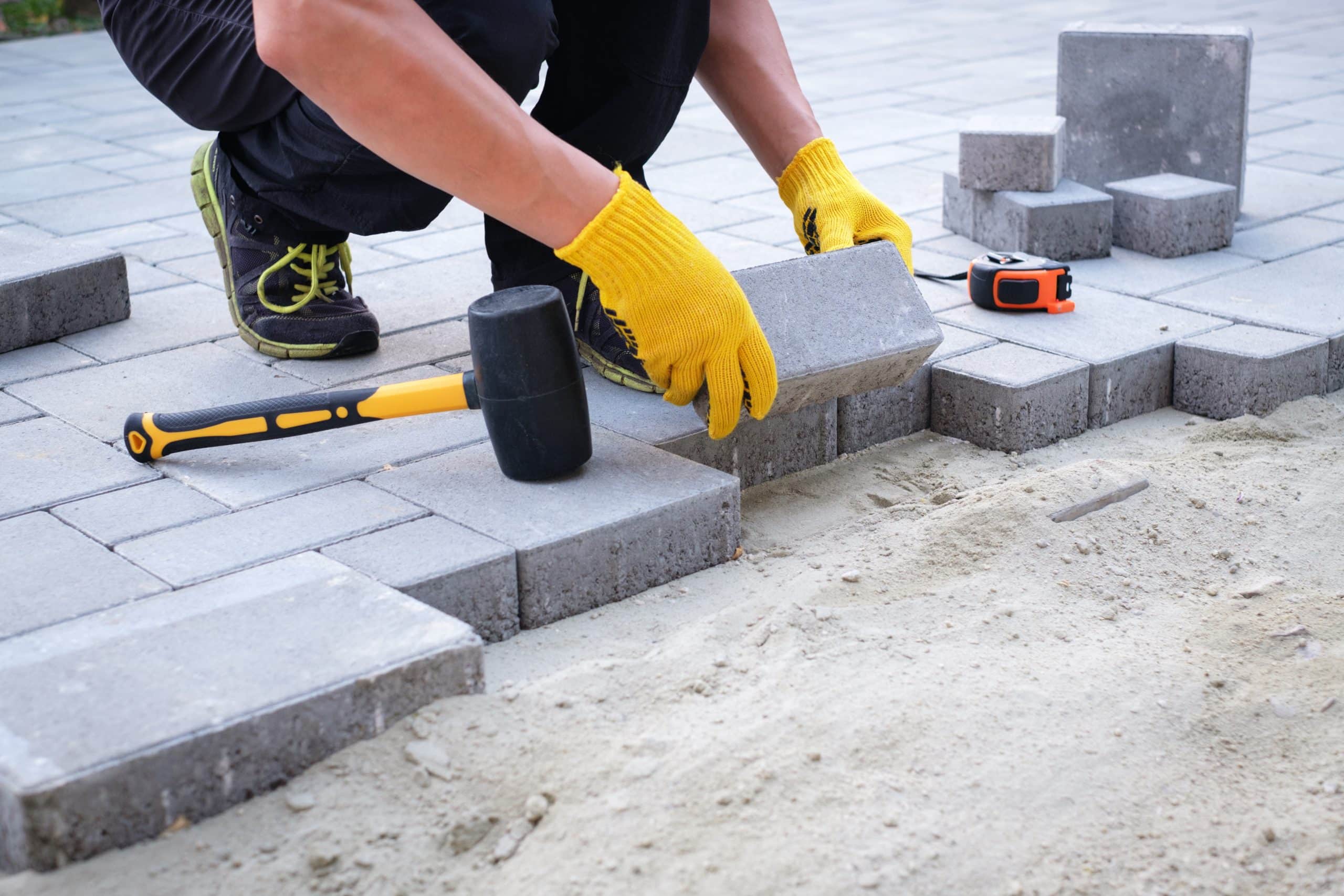
Not every property is the same, and permeable driveways aren’t a universal solution that works identically on every site. Nassau County has a range of soil conditions, and clay-heavy areas present a real challenge for permeable systems. Clay doesn’t absorb water quickly, which means a permeable surface alone may not be enough — some sites require underdrains built into the base to move water away from the reservoir layer and prevent it from backing up.
This is the part that most cost guides skip over entirely. They give you a per-square-foot number without mentioning that site conditions can shift the total significantly. A property with good soil permeability and a modest slope is a straightforward install. A property with heavy clay, a flat grade, and existing drainage issues is a more complex project — and a contractor who doesn’t assess those factors before quoting is one worth being cautious about.
Nassau County has an active Stormwater Management Program working with the state Department of Environmental Conservation to address exactly this kind of runoff problem at the county level. The Town of Hempstead installed a permeable paver demonstration project, including a driveway and several walkways, at their Clean Energy Park at 1401 Lido Blvd. in Point Lookout, NY. If you want to see what a well-installed permeable driveway actually looks like before committing, that’s a real, local installation you can walk up to and examine.
Before you decide on a material or a budget, understand your site. What’s your soil like? Where does water currently go after a storm? Does it pool near the house, run toward the street, or disappear quickly? Those answers shape what kind of permeable system makes sense — and whether you need a contractor who has experience with the more complex installs that Long Island’s coastal, clay-heavy terrain sometimes requires.
**Do permeable driveways require a lot of maintenance?** They require some, but less than most people expect — and far less than the ongoing repair cycle of a damaged concrete or asphalt surface. The joints need to stay clear of compacted debris, which means periodic sweeping and occasionally vacuuming out the aggregate to restore drainage. That’s manageable. What it’s replacing is the annual spring assessment of what the winter did to your driveway, followed by a repair call that costs $500 to $2,000 or more. Most Nassau County homeowners who make the switch find the maintenance trade-off works in their favor.
**Can permeable pavers handle Long Island winters?** Yes — and they’re specifically better suited to freeze-thaw conditions than rigid surfaces. Because water drains through the joints instead of sitting under the surface, there’s less water available to freeze and expand beneath the base. The pavers themselves are interlocking, which means they can flex slightly with ground movement rather than cracking under pressure the way a solid slab does. This is a meaningful structural advantage in a climate that delivers 30 to 40 freeze-thaw cycles a winter across Nassau County.
**How do I find a contractor who actually knows how to install these correctly?** This is the question that doesn’t get asked enough. A permeable system installed without the proper base depth, the right open-graded aggregate, and correctly sized joints loses most of its drainage benefit. It looks the same on the surface, but it doesn’t perform the same. We’ve built relationships with experienced local Long Island contractors over the years, and connecting homeowners with qualified installers is something we do regularly. If you’re not sure where to start, that’s a good reason to come into our Roslyn Heights, NY showroom before you start collecting quotes. We can point you in the right direction and help you understand what to look for — and what to ask.
**What if I can’t afford a full driveway replacement right now?** That’s a fair concern, and it doesn’t have to be all or nothing. Some homeowners start by addressing the most damaged sections and planning a full replacement over two seasons. Others find that the total cost, once they’ve added up what they’ve been spending on repairs, is closer to what they’ve already been paying than they expected. It’s worth doing the math honestly before assuming the upgrade is out of reach.
If your driveway is already showing signs of stress, the honest answer is that another winter won’t make it easier or cheaper to fix. The freeze-thaw damage that Long Island delivers every year is cumulative — each season compounds what the last one started. September is the window. After that, the ground closes up and the options narrow.
A permeable driveway isn’t the right answer for every property or every budget. But for Nassau County homeowners who are tired of the repair cycle and want a surface that’s actually built for the climate, it’s worth a real conversation — not just a quote from a contractor who’s never discussed your soil type or drainage pattern.
If you want to see the materials in person, talk through what makes sense for your property, or get connected with a contractor who knows how to do this right, stop by our Roslyn Heights, NY showroom or reach out to Powerhouse Mason Supply directly. We’ve been helping Long Island homeowners navigate these decisions for over 25 years, and we’d rather spend 20 minutes with you now than watch you call us in April about what the winter did.
Article details:
Share:
Continue learning: